What happens when you exercise in the heat?
Exercising in the heat places severe stress on the human body and will impair performance. Athletes who aren’t used to living, training and competing in warm climates are placed at a disadvantage when an event is scheduled for hot and humid conditions. Implementing an acclimation strategy is the best way to overcome this. The physiological response to exercise in the heat is determined by the intensity of the exercise and heat stress. Exercise in the heat results in a higher heart rate and a higher cardiac output, as well as higher core and skin temperatures.
The main two problems when exercising in the heat are the increase in core body temperature and dehydration. About 75% of the energy turnover during exercise is wasted as heat, which causes body temperature to rise. When the environmental temperature exceeds skin temperature, heat is gained and the body temperature can rise to dangerous levels. Once your core body temperature gets above 38.9°C, you start to experience a significant drop in performance. Your body can no longer effectively cool itself and will start diverting more blood to the skin in an attempt to cool you. The longer you’re exercising in the heat, the more sweat you lose trying to cool yourself. This speeds-up the dehydration process and consequently, you cannot maintain your desired exercise intensity.
So how can you optimise race performance, and not overheat?
Whilst undertaking some heat acclimation is the ideal strategy to help you cope better in the heat, whether you are acclimated or not, understanding how you respond to the heat will help you tailor your race strategy appropriately. This is particularly relevant if you are doing a long event (eg 70.3 or Ironman) where you can’t really test out in advance what an appropriate intensity will be.
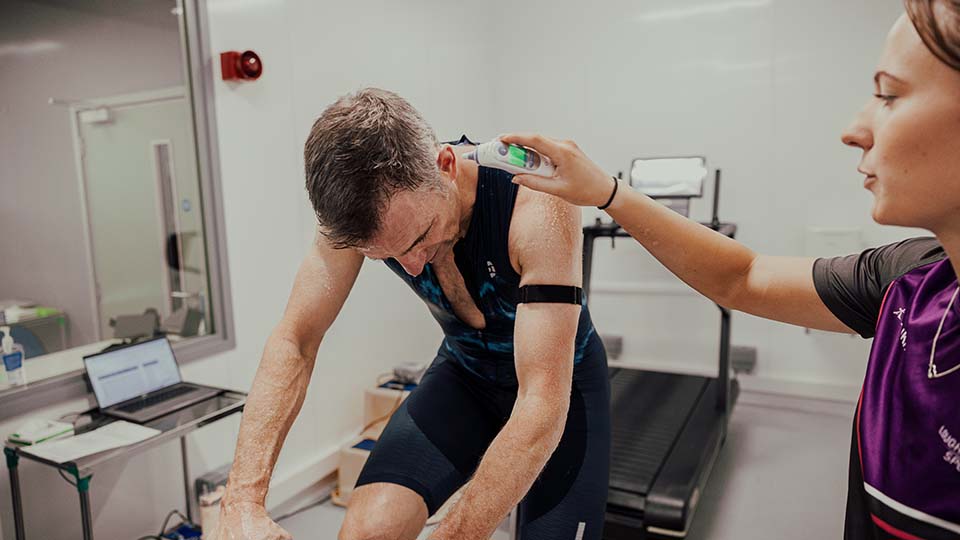
At Loughborough Sport we can put you through a heat tolerance test where we look at your physiological responses to an hour of exercise at target race pace, in the environmental conditions you are likely to experience during racing.
During the hour of exercise we will monitor your heart rate, tympanic temperature and perceptual responses. We assess how well you are able to keep your temperature under control during the exercise bout. If you are able to keep your temperature from rising too much, the exercise intensity you have been doing is likely to be appropriate for race day. If your temperature rises at a rate such that over the duration of the race it will exceed 40C, this intensity is too high for race day. We will also look at what changes in intensity do – if your temperature rises with an increase in intensity and continues to rise even when exercise intensity drops, you will have to be more careful on race day. However if temperature stays stable, you likely have more opportunity to put in some harder efforts if needed.
During the session we will also measure your sweat rate, sweat sodium concentration and hydration rate. We can then advise you on an appropriate hydration strategy for your race, and also discuss cooling strategies that may be useful.
So if you don’t want to leave pacing to chance, book in for a heat tolerance test with the Loughborough Sport Physiology team, to optimise your race strategy this summer.