Portfolio guidance: Design and Creative Arts (PGT)
Applied Storytelling (MA, PGCert)
Fine Art (MA)
Graphic Design and Visual Communication (MA)
Integrated Industrial Design (MSc)
Illustration MA
User Experience Design* (MA/MSc)
User Experience and Service Design* (MA/ MSc)
Most Postgraduate applicants require a portfolio to evidence their practical work, which will be reviewed by our highly skilled academic staff.
A design portfolio is a visual way to show your design skills and your potential. It lets you present the different sides of your ability.
The following sections provide general advice for applicants, applicable to all. Students come from different educational backgrounds and have studied different qualifications, so your portfolio should show a range of suitable skills.
Please remember that this is only a guide.
If you have any further questions, please email us at: sdcaadmissions@mailbox.lboro.ac.uk
*These programmes will consider applicants from non-design backgrounds (e.g., psychology) without portfolios, but require a strong personal statement, CV, and Undergraduate transcript. Applicants from design backgrounds must have a portfolio.
** Ergonomics does not require a portfolio
Introduction
Welcome to the School of Design and Creative Art guide to portfolios. We want to see your work at its most beautiful, and to discover how good you are.
A design portfolio is a visual showcase of your abilities. It helps us understand your creative thinking, skills, and design journey so far. Think of it as your opportunity to tell your story through your work.
An effective portfolio showcases your design craft skills, ability to engage with diverse users and technologies, and your creative approach to design and decision-making. As such, no two portfolios should be the same.
Your portfolio will be assessed by our panel of experienced academic staff as part of the admissions process.
Be selective
Be selective on what you show. Don’t include everything.
Open your portfolio with your strongest project, not necessarily in the order they were completed. For example, if you’re applying to study Graphic Design, then start with your best piece of Graphic Design work.
There are thousands of different ways to make a portfolio.
We’re looking for evidence that you will work hard and perform to a high level.
As a top-ranked Art and Design School, we’re fostering future leaders and want to see if that may be you.
Focus on showing how excellent you are more than following a set formula.
The front page
Include your full name: e.g., Xiaoli Tian.
The front cover should be both:
- Aesthetically attractive.
- Represent what we will find inside.
We care about your work and want a good match between the outside and the inside.
The cover sets us up for the work to come.
Which software?
Whatever software you choose to author your portfolio, we ask that you send us your work as a PDF file. We ask this because:
- The PDF file will keep your design - the fonts, the colours and the images - looking like they do on your device, regardless of the computing device we are looking at your work on.
- A PDF will properly save your URLs/Links and media internally.
- A PDF allows you to set the compression of your files so that you can meet our file size requirements, while not doing damage to your images and other media content.
Authoring software that works:
Microsoft PowerPoint, LibreOffice Presenter (Free), Apple Keynote (Free on MacOS), Figma, Adobe InDesign, Canva Affinity (Free with a free Canva account).
File size = no more than 15 MB
File type = PDF
Name your file clearly, in this way: Portfolio - Family name, Chosen name.pdf. E.g., Portfolio - Tian, Xiaoli.pdf
How big?
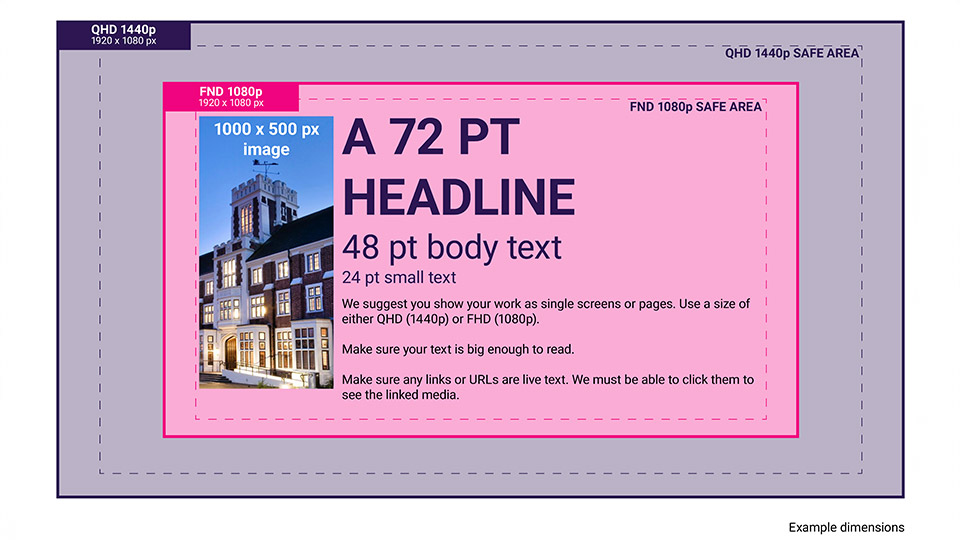
- 1000x500px image
- A 72pt Headline
- 48pt body text
- 24pt small text
We would suggest that you present your work as sets of individual screens or pages formatted at either QHD (1440p) or FHD (1080p) sizes.
Make sure that your text is large enough to be read.
Make sure that any links or URLs are presented as live text that can be selected so that we can view the linked media.
- QHD 1440p = 2560 x 1440px
- FHD 1080p = 1920 x 1080px
Screens
Create your portfolio with two screens side by side, or just one single screen — no more.
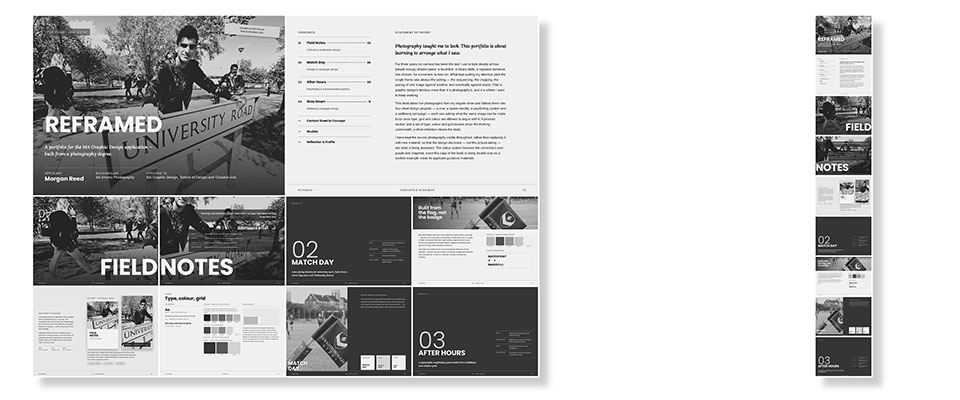
If you put four or more A3 pages on one screen, your work becomes very hard to read. It also makes it hard for us to decide whether to offer you a place.
Good examples: A single page, or a real two-page spread shown at full size. Show one idea that they eye can see all at once. There is space for the design to breathe, or even to flow from one page to the next
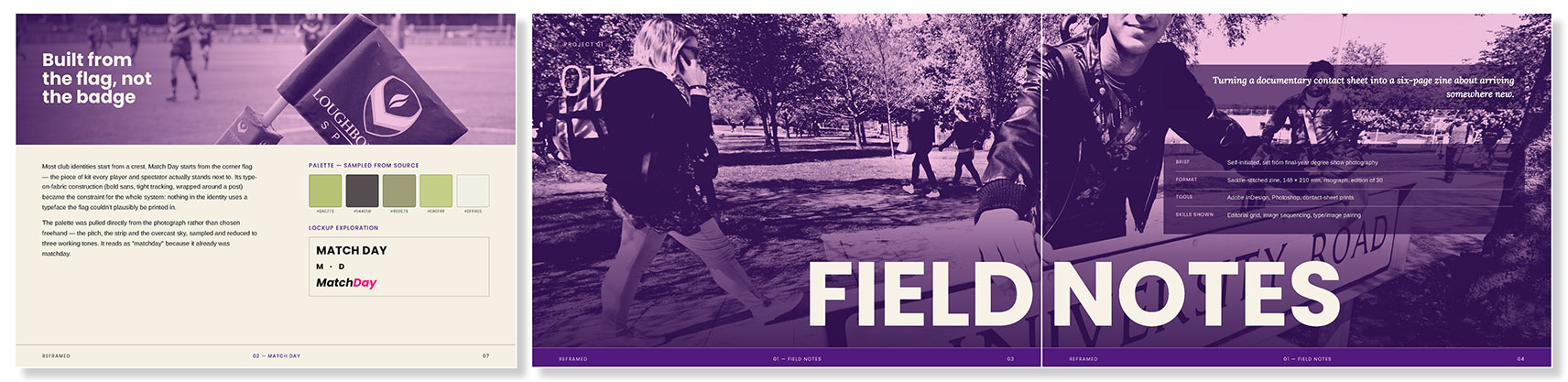
Bad examples: Fitting manage pages onto one sheet. Each page becomes too small to read. There is no longer any space or rhythm between the pages. Putting every page onto one long column. This makes it hard to read. There are no separate pages anymore, just one long strip.
How many case studies?
3 to 5 case studies or projects max
Between 3 and 5 (maximum) case studies or projects show your range of skills and your appropriateness for our Programmes here at Loughborough University School of Design and Creative Arts.
- Less than 3 case studies suggests you may not be ready for a Master’s study.
- More than 3 case studies suggests that you can’t decide which of your work is important, and which isn’t.
We suggest that you include 10 to 20 pages of work total. Show us quality over quantity.
Example case studies:
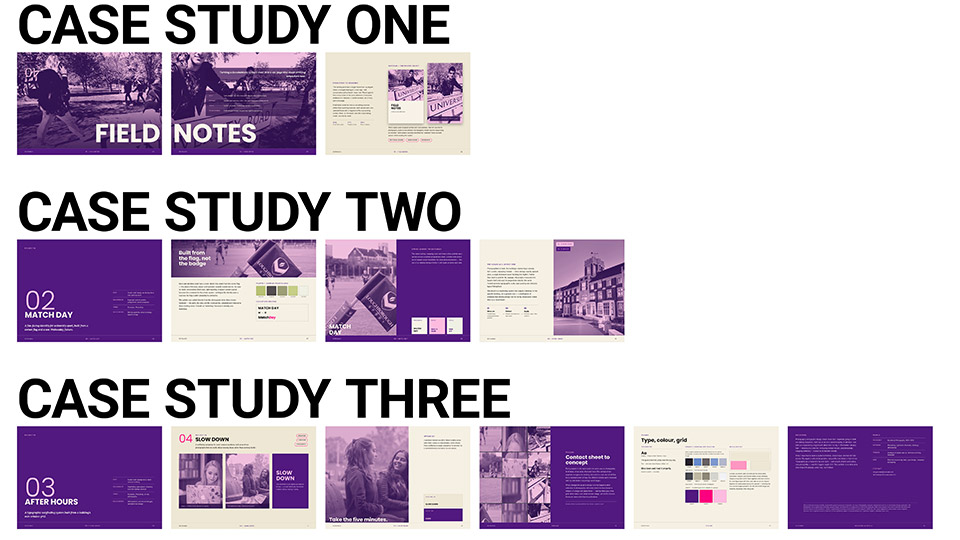
Tell us the whole story
Go into as much detail as possible. If you don’t write about it, then we can’t know about it.
- Talk to us on the page!
- What was the problem you’re addressing?
- Why is that problem important?
- How did you address the problem?
- Visualise the final outcome?
- Reflect on if you solved the problem?
Page layout
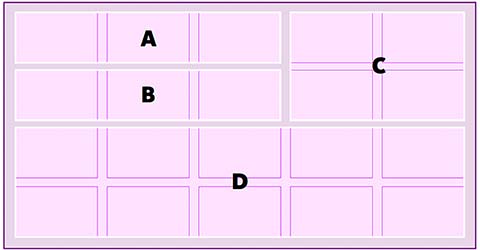
Contextual opportunity
- Your Project Title
- A short introduction to the project and the programme it came from (e.g. BSc. Human Factor Design).
- Your personal definition of the brief/problem and the user/context.
- Evidence of the research you carried out and the key insights that you have discovered.
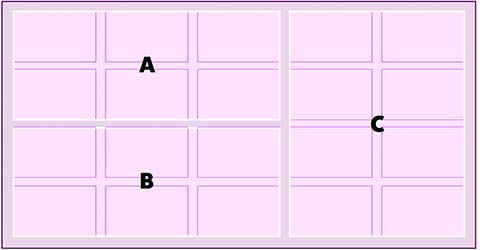
The design process
- Rough ideation sketches.
- Analogue or digital developmental sketches
- Digital modelling and/or physical prototype exploration
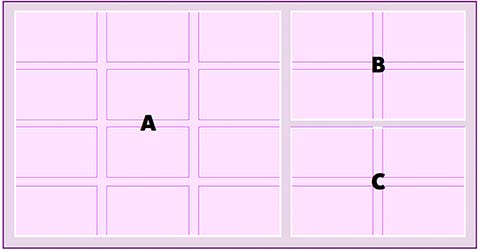
The final design in use
- A ‘hero’ image of the proposed product and the key features
- Product in use showing how the final design works and/or how the user interacts with it.
- Final functional testing and/ or user evaluation
Citations
Tell us the current news and cultural context that makes your work relevant. This could be: analysis of existing designs, art shows, films, social media or reports.
This collected information should be backed up with proper academic citations.
Citing the research shows you understand how academic thinking works and that you care about detail.
Learn how to cite your work properly with a range of resources from Loughborough University Library.
Good example
Liao et al. (2025) show that the global supply chain is not prepared to develop the dynamic capabilities needed to make drone technology sustainable.
References
Liao, C., Parker, C.J. and Parkhurst, G, 2025. Envisioning Sustainable Future Flight Ecosystems. In Future Flight Governance (pp. 226-242). Routledge
Bad example
Research shows that the global supply chain is not prepared to develop the dynamic capabilities needed to make drone technology sustainable.
Individual or group
Be open about your work.
Tell us which part of the work you are presenting is your own work, and which is a group project. You are welcome to include group work in your portfolio, but we need to clearly see what your contribution to the project is. Add a text box at the front of the case study explaining what you did.
Work experience/internship
You can include case studies of work you have created during employment or internships.
They may only be one or two pages long, but they are excellent to show your real-world skills.
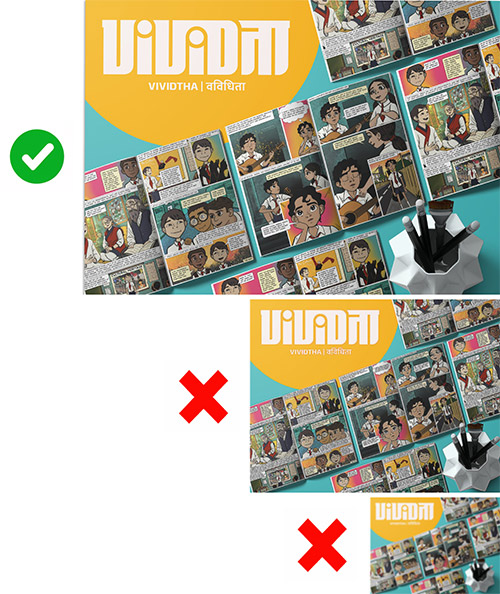
Make every picture clear
If it’s too small, we cannot see your work!
Review your Portfolio PDF on a laptop before you submit it. If you cannot read it on a smaller screen, then neither can we.
- Your picture should be clear. Your text should be readable.
- If your picture is over-compressed, your work will look weak.
- If your pictures are fuzzy/ pixelated, then we cannot see what is going on.
- If the picture is too small to see what is going on, then we can’t understand it and will ignore it.
Make every word count
English does not need to be perfect — but your portfolio should be clear and carefully checked.
If English is not your first language, writing your portfolio may take a little more time. That is completely normal.
Before you submit:
- Use the spell checker in the software you are working in (e.g., Canva).
- Read your text again for simple spelling and grammar mistakes.
- Keep your sentences short and clear.
- Ask someone else to read your portfolio if possible.
We are interested in your ideas and your thinking, not perfect English. However, frequent spelling mistakes can make your portfolio look rushed and can make your work harder to understand.
A careful final check will help your work make the best impression.
AI use
Good (be honest)
If you use AI in your case studies, we want to know:
- Which AI
- Why you used it
- How you used it
- What you learnt from using it
While AI can be a powerful tool for designers, ensure you are in charge of the critical thinking and decision-making. If you use AI, cite it, include your prompts, and explain how it formed part of your design process.
Bad (be VERY honest)
Generative AI has a slightly ‘strange’ writing style, and we can tell (especially if your IELTS score is low and your cover letter uses complex English).
Just be yourself; we want to know you.
We will judge obviously AI-generated (and not explained) work poorly when we review your portfolio. Applicants who submit a series of AI-generated case studies will be rejected.
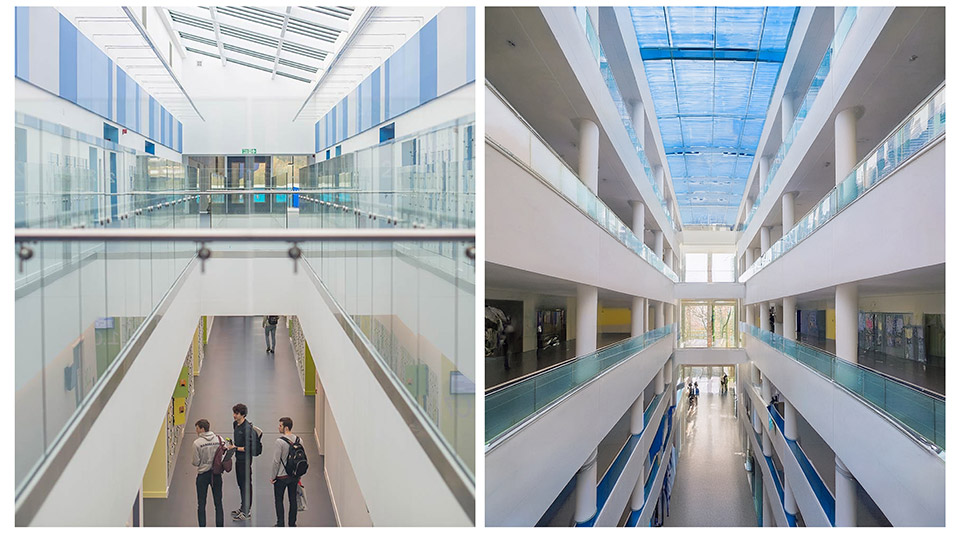 Left image: Good example of real work. Right image: Bad example using AI-generated images without saying clearly that they are AI-generated, and not made by you.
Competitions
Show your success.
Include any competition work in your portfolio. Show the final work! Entering competitions is valuable because it shows:
- External recognition of your ability
- Motivation and passion for your chosen design or creative field
- Engagement beyond classroom learning
This helps us understand your commitment to the profession and your drive to grow as a designer or creative practitioner.
Programme specific advice
Fine Art (MA)
Programme specific information (Fine Art, MA)
Please send a PDF with 20 pages. Use it as follows:
Page 1 — About your work
Write up to 150 words about your artistic practice. Tell us what your work is about.
Pages 2–15 — Your artworks (14 pages)
Use most of the pages to show the artworks that best represent your artistic language and your way of working.
Pages 16-18 — Your process (3 Pages)
Show tests, trials, and experiments. We want to see how you make your artwork.
Pages 19-20 — Your professional work (2 pages)
Show exhibitions, commissions, or professional projects you have taken part in.
Pages 2-20
Please give the size (dimensions) of each artwork, the materials (media) you used, and the year you made each work. You do not need to write anything else, because your statement on Page 1 covers this.
Graphic Design and Visual Communication (MA)
Programme specific information (Graphic Design and Visual Communication, MA)
- First page of portfolio: a brief summary of what's in the portfolio. This acts like a contents page, and should explain the topic/theme, function and form/format of each project included in the portfolio.
- When presenting each project, try to answer the following questions with what you present us: 1) Who is this design for? 2) What is the issue you're addressing and/or communicating? 3) How did your design ideas develop? 4) Why have you chosen the specific format of graphic design for your final outcome?
- Use annotations, diagrams, flowcharts, mind maps etc. to showcase your design thinking process, rather than large chunks of running text. This is important, because if you're a good graphic designer/visual communicator, you should have no problem showing your thinking in visual ways.
- Put your portfolio together in a style that is uniquely yours, reflects what you're good at, and your personality.
- Try to include a good balance of commercial projects (to show that you can work in the industry), experimental projects (to show your innovation) and self-initiated projects (to show your enthusiasm). Please make sure you note your project types.
Illustration (MA)
Programme specific information (Illustration, MA)
Please send a PDF, no more than 20 pages:
Show your practical skills: Most of all, show us that you can draw and show us work that is of high quality.
Show us how you think: Include interesting projects about topics that matter. Show us how each project grew and changed.
Show how each project works in real life: Show us that you thought about who the work is for. If you can, present each project in the format it was made for.
Show us who you are: Help us understand what kind of artist and designer you are through the projects you choose.
Show us motion and animation projects: If you have these types of projects, then show us by using storyboards, screen, and character modelling.
Integrated Industrial Design (MSc)
Programme specific information (Integrated Industrial Design, MSc)
Please send us a PDF. It should be about 25 pages long, and no more than 30 pages. Include the following:
Page 1 — Your interests
Tell us your three main interests in industrial design. For example: innovation, sustainability, inclusion, technology, problem solving, creating value, or self-expression.
Projects — 4 to 5 pages for each project
For each project, try to show:
- Not just the final idea, but your first ideas and how you considered more than one potential route to a solution.
- How you developed the idea you chose, step by step. Show how the design changed and improved with each version.
- How your final design is used and interacted with. Add labels with short notes if required to help people understand it.
We are less interested in 3D printing, digital rendering, or the use of generative AI.
We are more interested in:
- Projects with a clear and useful purpose, and solutions that suit the problem.
- Evidence that you explored different options. We do not want to see a simple, straight path from start to finish.
- New ideas in how a product works, how people use it, or how it looks. A change of style alone is not enough.
If possible, show simple, rough models or mock-ups in one project. This shows that you understand prototyping and physical making, not only digital skills.
Remaining pages — Your other work
Show your other interests and examples of related work. Students often include art, photography, model making, basic electronics or programming, 3D printing, and AR/VR.
The whole portfolio
Your layout and graphic design should be consistent across all pages. We also want to see good presentation skills.
User Experience Design/Service Design (MA/MSc)
Programme specific information (User Experience Design/ Service Design, MA/MSc)
This guidance covers User Experience Design + User Experience and Service Design
1. Focus on UX and service design case studies
Choose case studies about user experience or service design. UX means "user experience" — how people feel when they use technology, a service, or a space. Show your best work in this area. Focus on how users feel and behave, not just how the design looks.
2. Show your thinking, not just your output
Good images matter. But how and why you made them matters more. Explain your process in your own words. Tell us what you did, why you did it, and how.
3. Show a range of skills within UX and service design
Show different skills within this field — for example, research, prototyping, testing, and service mapping. This helps us see that you can work across the full design process, not just one part of it.
4. Present genuine user research
Good UX and service design research means understanding people. This includes how they work, think, feel, and behave — across a product, a service, or a whole system. A few questions are not enough. Show real research that helps you understand people's lives and needs.
5. Explain how insights become actions
In UX and service design, you must connect research to design. Show what you learned about people's needs. Then show how this insight led to a real design decision — whether that's a product feature, a service journey, or a touchpoint in a wider system.
What if I do not have a portfolio?
*User Experience Design (MA/MSc) and User Experience and Service Design (MA/MSc) will consider applicants from non-design backgrounds (e.g., psychology) without portfolios, but require a strong personal statement, CV, and Undergraduate transcript. Applicants from design backgrounds must have a portfolio.
Integrated Industrial Design (MSc) applicants must have a portfolio to showcase their existing design skills, especially Computer-Aided Design (CAD). This is because the programme starts with advanced skills. Students who cannot demonstrate core design and CAD skills will not receive an offer.
Graphic Design and Visual Communication + Applied Storytelling both require a portfolio showcasing their creative/ practice abilities.
Ergonomics programmes do not require a portfolio.
Got questions?
Get in touch with our friendly admissions team if you have any questions about submitting an application or replying to an offer.
Admissions Team