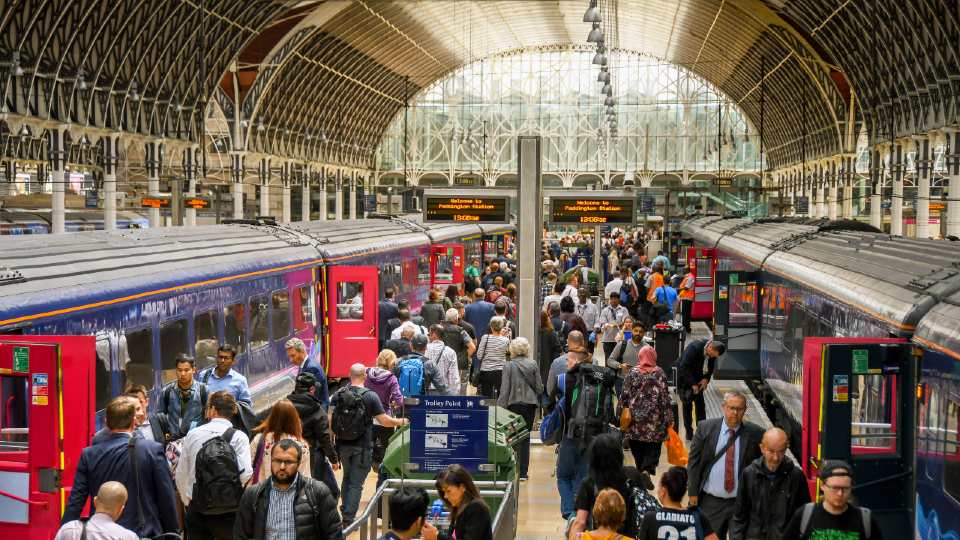
Created through a collaboration between Loughborough University computer scientists and rail technology company, TrainFX, the innovation aims to help operators better manage capacity, improve passenger information, and reduce overcrowding across the network.
Currently, operators often rely on delayed or incomplete data, meaning some carriages become overcrowded while others still have space available.
To address these challenges, the research team developed an AI-powered system that can estimate how crowded each train carriage is in real-time, even during busy rush-hour periods and in low-light conditions.
The technology uses depth-sensing cameras and onboard AI to monitor passenger numbers and movement throughout the network. Rather than recording conventional video footage, it captures depth information only, allowing passenger flow to be monitored without identifying individuals.
“This collaboration shows how responsible AI can support the future of transport”, said Professor Baihua Li, an expert in AI and computer vision and the Loughborough University project lead.
“By processing passenger flow data onboard and using privacy-conscious depth-imaging technology, the system can provide real-time carriage occupancy insights to operators and passengers.
“Our aim is to develop AI that is not only technically robust, but also trustworthy, practical and centred on improving the passenger experience.”
Embedded directly within TrainFX’s Smart Passenger Information System (Smart-PIS), the technology allows data to be processed directly onboard trains and live occupancy information to be shared with operators and station staff.
For operators, the system could support improved scheduling, more effective crowd management and longer-term service planning. In the future, the data could be shared with passengers, allowing them to identify less crowded carriages before boarding.
The multi-camera prototype has already been installed and tested within TrainFX’s simulated environment, where it monitors passenger movement around train doors and carriages. Researchers say the AI model has shown high levels of accuracy and reliability during testing.
The prototype is now ready for live train trials, with TrainFX working alongside train operators on the next stage of deployment in public railway environments.
The Loughborough University and TrainFX collaboration was funded by UK Research and Innovation (UKRI) through a Knowledge Transfer Partnership (KTP) – a UK government-backed initiative that connects businesses with university researchers to drive innovation.
The project recently won the AI Tech Innovation of the Year category at the Made in the UK Midlands Awards 2026.
Hansoon Han, Managing Director at TrainFX, said: “Overcrowding is one of the biggest frustrations for passengers, especially when some parts of the train are much busier than others.
“This project is about giving operators better real-time information, so they can manage daily services more effectively and build a clearer picture of passenger demand over time.
“Working with Loughborough University has helped us apply advanced AI research to a real rail challenge, supporting the kind of insight operators need to improve journeys and make better use of capacity.”
The academic team included Professor Baihua Li, Professor Qinggang Meng, Dr Mohamad Saada, and Dr Haibin Cai, with day-to-day research and development led by Dr Sajanraj T. Dharmarajan, Syed Muneeb Ahmed and Dr Yixiao Zhang. The team acknowledge the contributions and strong support of Managing Director Hansoon Han and Assistant General Manager Dr Qun Zhu from TrainFX.