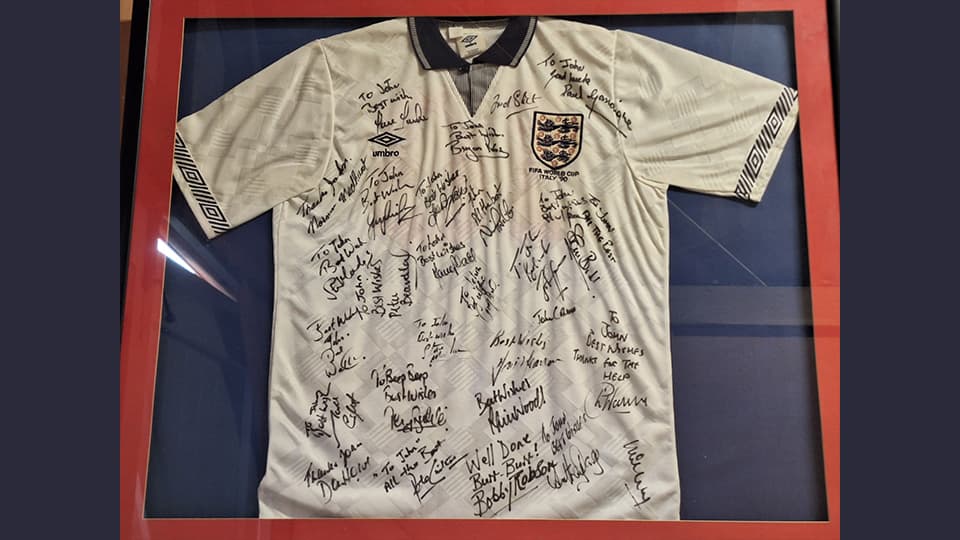
Sports science looked very different to the high-performance industry we recognise today. There were far fewer people imagining that science could sit at the heart of elite football.
John’s journey began at Loughborough, where he studied PE and Sports Science with Geography (BSc, 1983; Physical Education MPhil, 1986), before joining a renowned research group led by Professor Clyde Williams – during which time he was part of the work on the ‘bleep test’.
Following his time in Professor Williams’ research group, John’s early research was funded by Mars and focused on carbohydrate metabolism and endurance running, linking with events such as the London Marathon – a marathon John has since run 20 times.
John came to Loughborough as a sportsman. He never expected to end up in the lab and could only dream of heading to a World Cup to work with some of the biggest names in the game. That was until Bobby Robson visited Loughborough:
“When Bobby Robson came into the lab, the FA were looking for a sports scientist. That never happened in those days.”
A visit from the England Manager proved to be a pivotal moment in John’s career, and maybe even for the future of English football.
John became the Football Association’s first full-time sports scientist, tasked with establishing a pioneering Human Performance Centre at Lilleshall National Sports Centre in Shropshire. He was a sole sports scientist with players visiting him at the centre – highlighting the rareness of the expertise at the time.
Sports scientists were not part of a football teams’ backroom staff at the time – it was simply unheard of in English football. John’s role was revolutionary.
From fitness testing and monitoring to nutrition and training design, John helped introduce scientific principles into elite football.
“It genuinely was me. For the first six to eight months, I was the only one.”
John was later joined by Jackie Davis – a fellow Loughborough graduate (Education & Physical Ed BSc, 1985) – who assisted him at Lilleshall.
That pioneering work soon extended to the England senior team, with John joining Bobby Robson’s backroom staff ahead of Italia ‘90.
A schoolboy dream: the 1990 Italia World Cup
For John, travelling to the World Cup with England was a defining moment.
“It was just a schoolboy dream, really. I couldn’t believe I was going to the World Cup with the England team.”
His role focused on preparing the squad for the pressure and physical demands of tournament football, as well as the heat and humidity of the Italian summer – something that has clear parallels with tournaments held in warmer climates today and the upcoming tournament set for a weeks’ time in the USA.
John worked with the players at Lilleshall before the squad was whittled down to the final 22 players who would represent England. Using adapted fitness testing and close physiological monitoring, John tracked how players responded to environmental conditions, particularly changes in heart rate. Over time, he could demonstrate the benefits of acclimatisation:
“I could stand up in front of the players and show them how their heart rates had come down as they acclimatised.”
The impact went beyond physical preparation:
“It was mixing physiology with psychology, giving them the data that built confidence.”
Alongside this, John also advised on hydration, nutrition, and recovery, areas now supported by entire specialist teams, but at the time managed largely by one individual.
John stayed for the first few matches of the tournament in Italy:
“Fortunately, we didn't go to the really hot parts of Italy, but we had a kind of roadmap of what we should do with all the players planned during the World Cup.
“I came back after the opening rounds because I genuinely felt that my job had been done. I'd left them in a good place, and I felt that I'd done my job. I didn't want to outstay my welcome and just be a spare part, and I felt very proud and pleased with what I'd achieved.”
John gets a mention in Sir Bobby Robson’s autobiography, ‘Bobby Robson, Against the Odds’. John added:
“It normally just opens up on the right pages because I often read them, where he's very complimentary of the work that I did and says that, you know, I'd come along, done the tests and the players had all accepted that, and I was doing one-to-one sessions with them. And that would never have happened eight years ago with various other players.
“I’m always very proud of the fact that he publicly acknowledged the role that I played.”
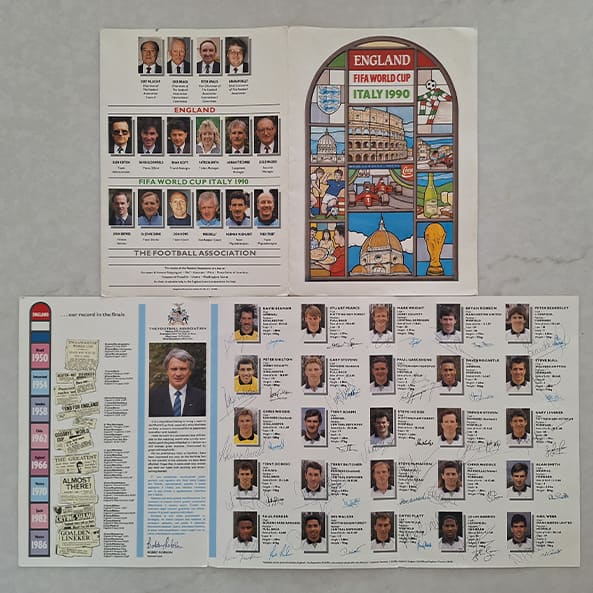
John’s signed copy of the England programme for the Italy 1990 World Cup
Despite its impact, sports science was still a new and sometimes contested space within football:
“It was often quite challenging working with staff who didn’t always accept the role, there was a lot of resistance at times.”
One example came in debates over matchday nutrition, where traditional approaches clashed with emerging science around carbohydrate fuelling.
Support from Sir Bobby Robson proved crucial, helping to embed a more evidence-based approach. Over time, attitudes shifted both within the squad and across the wider game.
Looking back, John sees this period as foundational:
“We helped to break down barriers and make sports science more acceptable.”
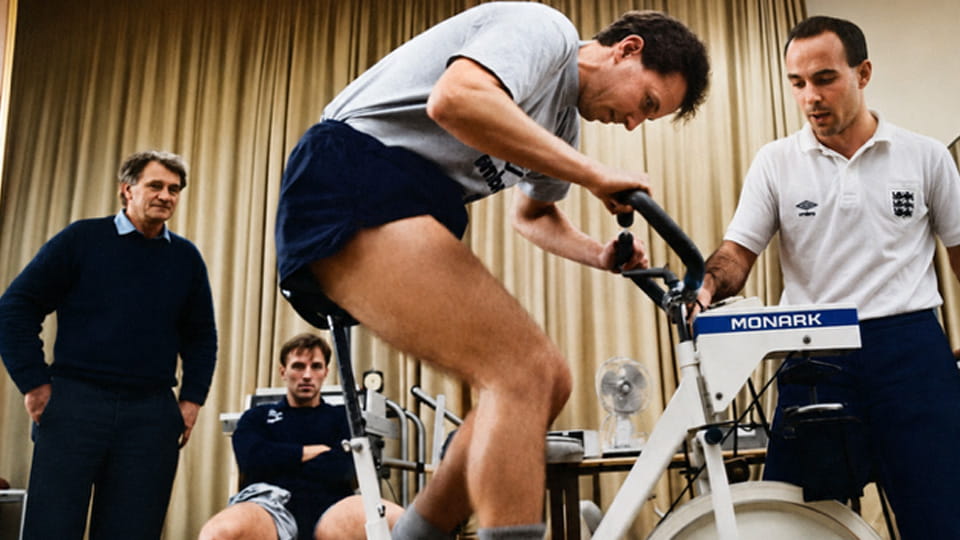 From left to right, England Manager Bobby Robson, and England players Gary Stephens (watching), Trevor Steven (being tested) and John Brewer. The photo was taken just before the World Cup in 1990 at the FA Human Performance Centre, Lilleshall.
England would go on to reach the semi-finals of Italia ‘90, with several matches extending into extra time – something John believes reflected the squad’s preparation:
“I think part of that is because the squad was as well prepared as they could possibly have been.”
Today, the scale of support behind an international team has transformed dramatically, with multidisciplinary teams spanning performance analysis, nutrition, psychology, and medical care.
“I suspect today there would be 15 to 20 people doing the work I did on my own.” John added.
It’s a shift that shows just how pioneering those early steps were – and with links back to Loughborough students, staff, and researchers.
Following the World Cup, John continued to shape the field of sports science across multiple sports.
He spent two decades developing performance services at Lilleshall, working across sports such as cricket and gymnastics. He moved into industry with GlaxoSmithKline, leading research and innovation for Lucozade Sport.
His career has also included roles with London Marathon, senior academic roles, governance positions in sport, and involvement at the highest levels of Olympic sport, including chairing British Handball and British Skiing.
John is now Chair of the Board of Trustees for the National Football Museum* – a full circle moment and one where he interacts with fellow alum Tim Desmond, CEO of the Museum (English and Drama BA, 1988).
Across it all, the Loughborough influence remained clear.
“I’d be the first to admit that I got my role because of Loughborough.” John said.
As another summer of international football approaches, John still watches the game through the lens of a sports scientist, analysing the details beyond the ball.
“I love watching what’s going on off the pitch as well, how substitutes warm up, hydration strategies… it might sound a little bit nerdy.”
It was the interest and curiosity that John still carries today that really launched his career in the sport industry and what has led to such a varied and interesting career.
Many thanks to John for sharing his story.
John has written several books and hosts a weekly podcast, Seasoned Strides, with former GB international and sub-4-minute miler Paul Larkin.
*The National Football Museum is offering Loughborough alumni discounted entry until September. Use the code LUOFFER20 when booking.
More from Loughborough alumni at the next World Cup
Catch alumni Katie Shanahan (Geography BSc 2014) and Lucy Ward (P.E.& Sports Science BSc, 1995 and PGCE, 1996) across World Cup coverage! Katie will be reporting for Fox News and Lucy will be commentating on ITV. We wish them both all the best.