Mathematical Sciences
The Department of Mathematical Sciences at Loughborough University brings together high-quality teaching, learning resources and facilities plus one-to-one guidance from the Mathematics Learning Support Centre to create a stimulating study environment. All our maths courses give students a solid grounding in the fundamentals of mathematics, but allow for additional specialism in areas such as statistics or mathematical finance.
Mathematical Sciences at Loughborough
Mathematics is an exciting subject which is not only fascinating to study in its own right but also underpins a great variety of endeavours such as science, commerce and industry.
Our maths courses are widely respected by employers and open many doors to employment and further study. They equip students with the numerical abilities, logical thinking and analytical skills that are highly valued within a diverse range of organisations.
The Department has attracted staff and students from all over the world, making it a diverse and stimulating environment in which to study. Active in high quality research across the broad spectrum of mathematics, the Department has an international reputation, with 100% of Mathematical Sciences research impact rated 'world-leading' or 'internationally excellent' in REF 2021.
The Department of Mathematical Sciences is part of the London Mathematical Society's Good Practice Scheme which supports mathematics departments interested in embedding equal opportunities for women within their working practices.
Our courses
Facilities
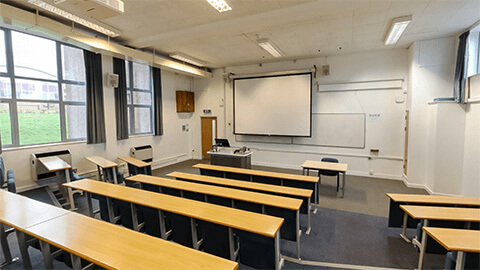
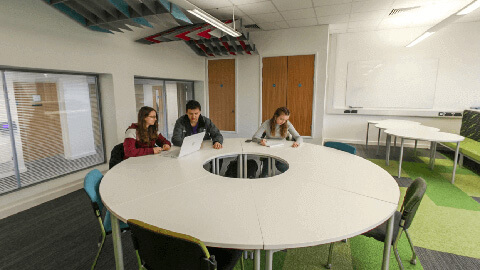
The Department of Mathematical Sciences is based in the recently refurbished Schofield Building providing modern teaching and study spaces, dedicated mathematics resources, and 24/7 access to computer labs.
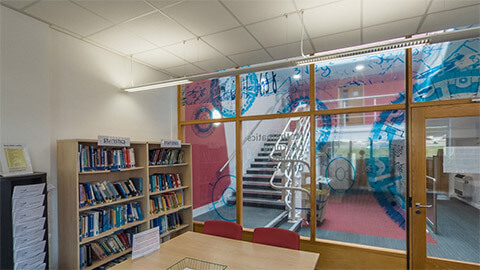
You will also benefit from the co-location with the award-winning Mathematics Learning Support Centre (MLSC), providing academic maths and statistics support to Loughborough students.
The MLSC offers free drop-in one-to-one mathematics and statistics support (and online sessions) with lecturers to help you with any challenging elements of mathematics you might experience. You can also use the centre for quiet independent or group study, and to make use of the many textbooks, computers, leaflets and workbooks, designed to enhance the learning experience.
Accreditation
Our BSc and MMath Mathematics courses and our Mathematics with Statistics course are accredited by the Institute of Mathematics and its Applications. Our Mathematics and Accounting and Financial Management course is accredited by the Association of Chartered Certified Accountants and the Association of International Accountants.
Career opportunities
All our Mathematical Science courses offer the option of a year-long professional placement. A year spent applying your learning in an industrial, commercial or research context gives you valuable work experience and may even introduce you to your future employer.
Our graduates go on to pursue wide-ranging careers include actuarial work (which involves application of probability and statistics), computing (particularly systems analysis and programming), financial work (accountancy, insurance, banking etc), management (which might involve operational research, a branch of applied mathematics), engineering (for example mathematical modelling and simulation in a design team), scientific research, design and development (perhaps using numerical methods and other techniques of advanced applied mathematics), statistical work (for example, Government departments) and teaching and lecturing.
Some of the major national and international companies our students go on to work for after graduating include KPMG, National Audit Office, Barclays and Experian, as well as in SMEs, local government, education and research.
The most recent Graduate Outcomes data (2021-22 survey, published 2024) shows a median annual salary of £31,000 for UK-domiciled graduates from Mathematical Sciences.
Our students


Placements
One year on placement
All our courses offer the opportunity to spend a year working in industry, giving you the chance to gain valuable skills sought after by employers. A placement year, which can be spent at up to three organisations, allows you to gain first-hand experience of a real role with real responsibilities. A year in industry will equip you with key knowledge and practical skills to give you a competitive advantage in your search for graduate employment.
Study abroad
Gain international experience with the study abroad option. Spend one year studying abroad, or at two partner universities for six months each, broadening your insights into a new culture.
Placement and study abroad
Make the most of your year by combining the two options by spending six months on placement in industry and six months studying abroad
One year self-employed placement
A Placement Year in Enterprise enable students to dedicate time to turning a business idea into reality.