When I first started thinking about my final year project, my main aim was to try to solve a real-world problem. I didn’t want to create something just for the aesthetics – I wanted to take an issue that genuinely affects people's lives and find a better way to address it. That’s how I came up with Acclivate: a device I’ve designed for runners that can help them acclimatise in the heat.
My idea began with an interest in the health risks athletes face, particularly heat-related illness. As climate change leads to hotter training and racing conditions, heat stress has become an ongoing challenge rather than an occasional risk. This is particularly true for runners, who rely heavily on sweating to cool down (something that’s easily compromised by humidity) and often have a drive to push through discomfort. I found that most runners follow generic acclimatisation protocols, highlighting a clear gap in the market for personalised monitoring.
This led to the concept for Acclivate: a system that measures physiological strain through heart rate and core body temperature estimation, translating complex data into clear, actionable feedback. Rather than simply tracking performance, it helps runners understand whether they are underprepared, adapting well, or at risk – supporting smarter, safer training and competition in increasingly challenging conditions.

The development of Acclivate went through some pretty distinct stages, and honestly the direction changed quite a bit along the way.
My early ideation was quite broad. I was looking at active interventions like cooling vests, ice packs, and heating wires, and I found that the market for these devices is very oversaturated.
The real turning point, however, came during an expert interview. As I’m studying at Loughborough, I was able to contact top researchers and lecturers in the fields of Sport Science and Ergonomics. One of them introduced me to the concept of human thermal lag, which basically means that reactive cooling devices cannot lower core temperature fast enough during a race to prevent harm. He also pointed out that, for a runner, any added weight directly hurts performance. That conversation forced me to completely rethink my approach. I moved away from trying to cool the athlete and towards giving them the information they needed to make smart decisions themselves.
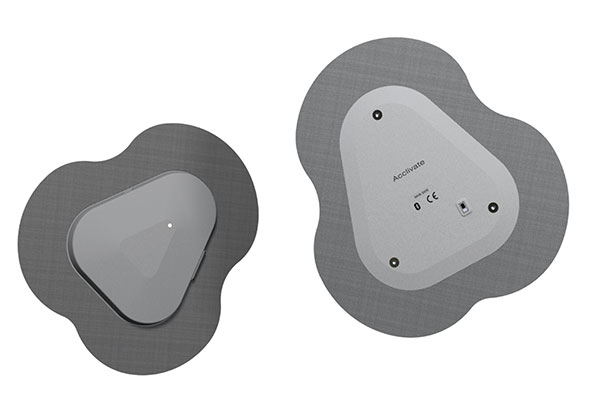
From there it was about figuring out the right technology to do that. It became clear that a chest-mounted heat flux sensor was the only way to get accurate core temperature data without being invasive or heavy. For the physical design, I didn’t want it to look clinical, so I went through a series of paper models and foam prototypes to get the scale, comfort, and aesthetics right. Geometric shapes felt too gadget-like, so I eventually landed on an organic, irregular shape, something closer to a polished river rock.
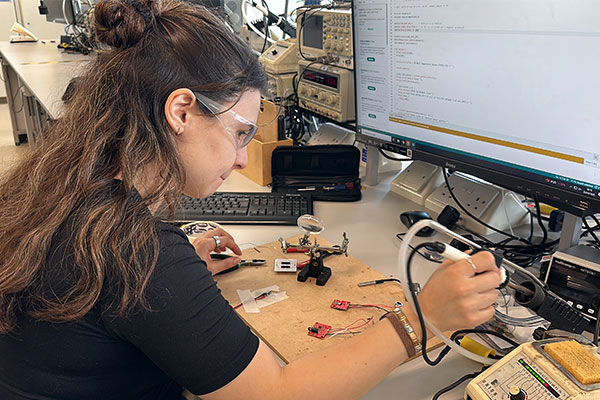
The resources available within the Design School were instrumental in bringing Acclivate to life. I used the Multi-Material Workshop to move the design from sketch to tangible object, the 24-hour PC suite to build a detailed CAD model of the project, and I’m currently using the Electronics Lab to test the sensors, assemble the circuit, and validate the firmware.
The Degree Show will be the first time my work is physically being seen by people, so I’m feeling a strange mix of nerves and excitement. There is pressure to make sure my project represents all the knowledge and skills I have learnt and developed these past few years, but beyond that, it feels like a meaningful way to finish.
It’s been a long process of research, pivots, and rethinking to get Acclivate to where it is now. Being able to put that in front of people and have real conversations about it feels like a proper conclusion to that journey rather than just handing in a final submission. This project has been the most complex thing I’ve ever tackled, so showcasing it feels less like showing off a finished product and more like proving to myself that I can take an idea from nothing and turn it into something real and functional.
I hope that when people see my project, it will spark conversation about how serious heat-related illnesses can be for runners, and how much guesswork is involved in training for hot conditions. The design is only useful if people understand the gap it’s trying to fill, and if Acclivate makes someone walk away thinking differently about how athletes manage heat, then that feels like a success to me.