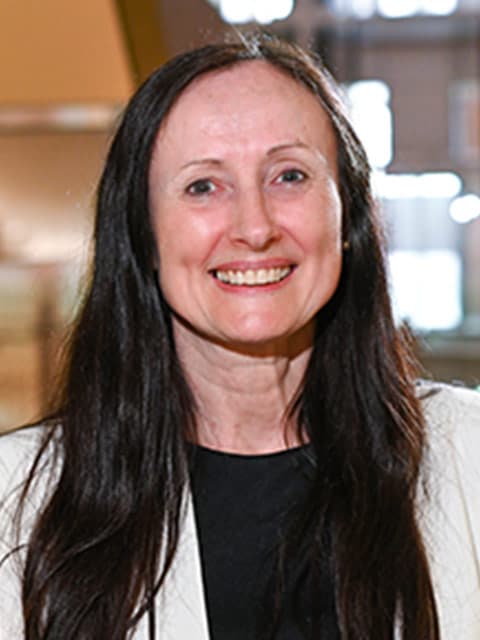
Please call the press office on 01509 223491 to arrange an interview with Dr Liz Varga. Bookings can also be made online at globelynx.com.
I am Liz Varga, Professor of Complex Systems at Loughborough University since 2026. I was awarded Commander of the Order of the British Empire (CBE) in the King’s birthday honours (June 2024) for services to critical infrastructure. I am a fellow of the following: Chartered Association of Building Engineers (FCABE); the Academy of Social Sciences (FAcSS); the Australian Risk Policy Institute (FARPI), and the Higher Education Academy (FHEA).
I was awarded BA (Hons) in Pure Maths and Data analysis/design (Open University, 1989). At Cranfield University, I was awarded an MBA (2002), a PhD on co-evolution using a complex systems perspective (2009) and became Professor of Complex Infrastructure Systems (2015). I moved to University College London (UCL), Department of Civil, Environmental, and Geomatic Engineering (2018) and set up the Infrastructure Systems Institute.
At Loughborough University I direct the cross-disciplinary Centre for Doctoral Training (CDT) on Artificial Intelligence in the Built Environment (AI4BE), solving engineering challenges by critical use of data science. I use digital methods including digital twins, computational ontologies, and AI and I am a member of the strategy board of the Data and Analytics Facility for National Infrastructure.
I am an executive of the 25 UK-university collaboration, established 2016, for Research in Infrastructure and Cities UKCRIC and a director of UKCRIC Services Limited which was a Manchester Prize Finalist 2024 for artificial intelligence to predict water systems leakage. I teach, write, speak, and advise globally on energy, transport, digital communications, water, and waste systems.
I am a commissioner with the National Preparedness Commission and the project manager for a new international standard ISO 22372 on infrastructure resilience for economic, social, and environmental good. My approaches are inclusive and leverage systems thinking and uncertainty quantification.
I am a complexity science academic passionate about transforming infrastructure outcomes for global society, through sustainable innovation, critical use of digital methods, and interdisciplinary, international collaboration. I have successfully delivered over 20 research grants totalling over £37 million via UKRI and the European Commission:
- pioneering the use of complexity science in infrastructure research across all its life cycle stages, diverse technologies, and societal outcomes, e.g. NPC, CECAN, water-energy-food nexus, green hydrogen
- introducing novel approaches for understanding, explaining and measuring systems of systems across disciplines and sectoral boundaries, e.g. ISO 22372, circular engineering, digitalisation for infrastructure resilience
- coordinating major research networks, programmes, and projects, e.g. UKCRIC 25 university collaboration, CDT AI4BE (16 offers/140 applications in 6 months)
- leading research into innovation and commercialisation
Current research
- Computable Epistemology: 2022-27. A formal representation for multiple competing claims enabling systematic analysis, comparison and judgement in deciding if consensus has been established, and by whom. Co-lead.
- Infrastructure Systems Review: 2026. A review of systems thinking in mega national infrastructure projects via analysis of outcome indicators and enabling factors. Academic lead.
- Competencies for Systems Thinking: 2026. Identification of systems thinking competencies from diverse disciplines in the built environment, creating the next generation of approaches to learning and uncertainty framing. Academic lead.
- Margins: Mapping of Net Resilience Gain of national infrastructure via complex network analysis and ISO223272; Singapore Ministry of Education tier 1 grant.
- Infrastructure Resilience Case Studies: 2025-27. I searchable compendium of success cases across the globe on adoption of infrastructure resilience principles (ISO22372).
I became a Fellow of the Higher Education Academy (FHEA) in 2016. I devised a new Masters in Infrastructure Systems which was first available in Sep 2023 (at UCL). I have designed, prepared, and taught modules on: complex infrastructure systems, digitalisation in infrastructure, circular economy in engineering, group project to address wicked problems in infrastructure, business case dissertation, public policy dissertation, and on systems, society and sustainability (SSS).
At Loughborough University my focus is on research outputs and doctoral training, although I will be teaching on two modules: BSB037 AI in Business, and the new BSc Data Science.
At UCL I was a head of the section on infrastructure and cities and led a team of Professors, Lecturers, and Research Fellows. I’ve made an exceptional contribution to post graduate studies through supervision of over 50 Research Fellows, Research Assistants and Doctoral Students and over 70 Masters (MSc and MEng) students. I am an active doctoral supervisor, engaging with industry and industrial groups relating to digitalisation of the built environment (such as 4DSIG, IDAIC, Water Data Task Force).
Industrial projects have included: adoption of circular economy and eco-design of construction minerals, decarbonisation pathways/options for major construction materials (concrete, steel, aggregates and diesel), and validation and automation of carbon assessment of major construction projects.
I embed research into keynote talks, at seminar, international conferences, and symposiums, bringing research into teaching and learning. I use feedback from industry to strengthen and iterate research insights.
I have supported a number of industrial and policy fellowships via RAEng and CECAN to engage on systems thinking and complexity science.
I am a recognised international academic including Visiting Professor at Hong Kong University, External Examiner at Cambridge University (FIBE3), academic lead at Built Environment Connective, and with past advisory roles on international standards (PAS:2080, ISO22372), CDBB digital twin hub, WEF, Royal Academy of Engineering, FCDO, etc.
Key words relating to my research interests include: infrastructure, built environment, flourishing society, digitalisation, hazards, threats, preparedness, disaster mitigation, decarbonisation, adaptation, complexity science, systems of systems, systems thinking, resilience, sustainability, innovation, uncertainty, interdependencies, systemic risk, integration, AI, machine learning, data science, ontologies, knowledge graphs, agent-based modelling, cyber-physical-human systems, nature-based solutions, circular economy.
I am writing a book to be published by Springer called Digitalisation for Infrastructure Resilience (expected late 2026).
I am accepting doctoral candidates primarily via the CDT AI4BE in any of the above topics. I am keen to support Knowledge Transfer Partnerships (KTPs).
I am an active reviewer of high impact journal articles, large funding schemes, and large funding grant applications.
I will consider invitations to more board appointments on multi-million GBP ventures, projects and programmes, in the field of integrated infrastructure (energy, transport, water, waste, and telecoms) where digitalisation (ontologies, AI, visualisations) is relevant, and where system of systems and/or a complex systems perspective.
Collaborating on international grant applications is also of interest, especially where they leverage collaborations with national institutes particularly in UK, New Zealand, Australia, Netherlands, Scandinavia, Hungary, China, South Africa, and USA.
I am keen on participating in special interest groups which push forward the boundaries of existing capabilities in digitalisation and systems thinking.