Loughborough alum offers life design guidance fit for an era of ‘undefinables’ in newly published book

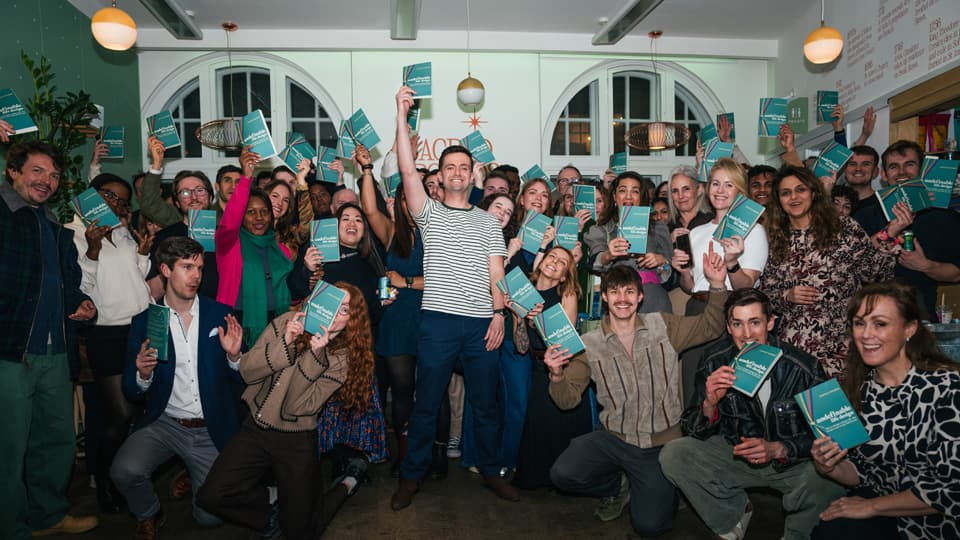
Alum Charlie Rogers with a large group of people holding his new book at a launch event.

Loughborough alum, Charlie Rogers, has taken an unconventional career path since graduating in 2020. In his new book ‘undefinable life design: How to design a unique life that sustains your energy and income’, he reflects on the valuable lessons he’s learned throughout his journey, and what it means to define yourself beyond your job in an age of career uncertainty.

“A fulfilling life isn’t about how many years you live, but how intentionally you choose to live them. Too many decisions in our lives are made by circumstance rather than by choice.

“I work specifically with people who feel undefinable, people who don’t fit neatly into a single label and who are trying to make sense of an era of rapid and increasing change. I understand that pace, and I help them turn that feeling of not fitting into a roadmap they can actually use.”

Since completing his BSc in International Business at Loughborough, Charlie has embraced tackling new challenges and helping others to find meaning through better tailoring their careers to their passions. Always self-motivated, he credits his time at Loughborough with helping to broaden his horizons and allowing him to build his entrepreneurial skillset through opportunities like his Year in Enterprise.

“I chose to study International Business for both the placement year and the chance to study abroad, not realising at the time I’d be more interested in building a business for myself than taking a placement.

“The chance to study in Denmark opened my eyes to life as an Erasmus student, and I was also able to attend a summer school in China, they were amazing opportunities to experience different cultures.

“My dad worked as a construction director and seeing him lead in a business was a real inspiration for me. I’d been involved in a few small business ideas when I was at school, but in my first year at Loughborough I had the chance to get involved with Enactus, an international social entrepreneurship project, which sparked a serious interest in working for myself.”

Charlie had a placement lined up to work in technology consulting for his third year but chose instead to take a Year in Enterprise. “I couldn’t shake the feeling I really wanted to take the opportunity to try building a business within a supportive setting. Once I secured a part-time marketing job which offered some financial security, I decided to just go for it, and so I spend my third year building a business called ‘Postey’."
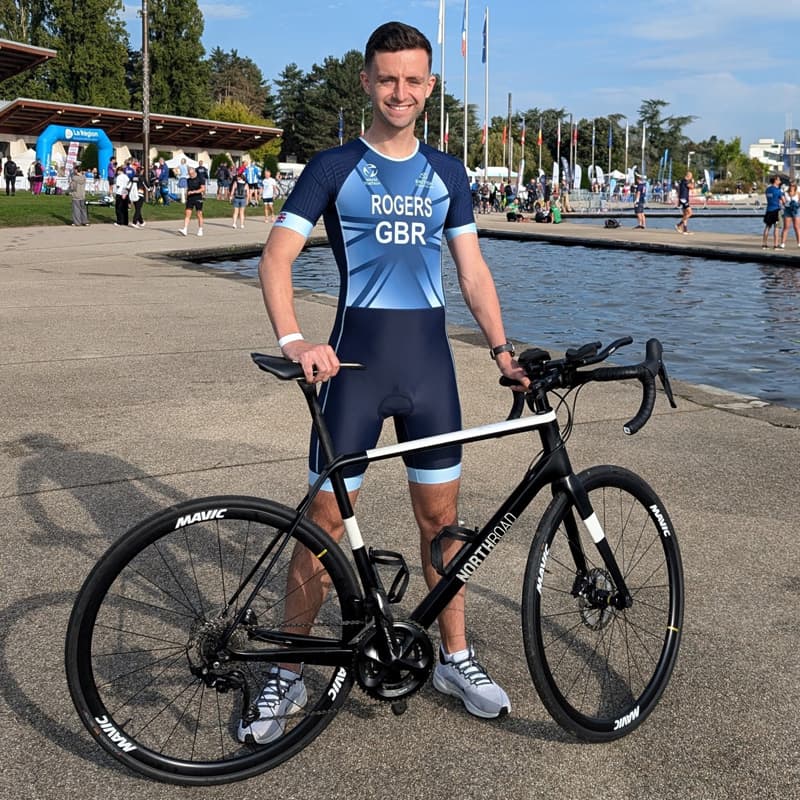
Charlie Rogers poses post-triathlon next to his bike.

“Going all in on my first business taught me the power, and the risks, of blind optimism. I genuinely thought, ‘Yeah, of course I can build a hardware product from nothing. Why not?’ I had zero experience, but eventually I found people who did. The three of us got developed our parcel box prototypes that could receive deliveries, and seeing that come to life was awesome.”

“However, by early 2020 I had to ask myself if I wanted to spend the next five years selling parcel boxes. I loved building a team and developing a business, but parcel boxes were not the one for me, so I closed the company.

“Then the pandemic hit. In April my one of my housemates and I decided to run an online hackathon with students who had lost their jobs. Nine students, three businesses. That idea became House Hack, a space where students solved real problems, businesses saw the talent in action and people got hired. It created a community of 37 team leaders, and we bootstrapped it for two years. That experience led to everything that followed.”

By 2023, Charlie realised his personal growth had slowed. “I felt like I was stagnating and I wanted to keep up that pace of growth, which was what had led me down so many different paths. The business was profitable, but I wasn’t pushing myself, so I closed it down and looked for something new.”

He gravitated towards the idea of ‘portfolio work’: short contracts, part‑time roles, four‑day weeks, freelancing, and building businesses on the side. He took on a formal role at The Portfolio Collective, a four‑day‑a‑week position as a Team Coordinator.

“I didn’t care about the job title, which was admittedly by conventional measures a step back from ‘founder’. I cared about the exposure to mentors, they taught me the emotional aspect of leadership and how to make money as a portfolio professional. I think it’s essential to be able to decouple the perceived ‘status’ of a job or title from the opportunity you’re being offered, exposure and connections.”

As Charlie worked with people whose professional lives were going through a transition, he began to recognise a pattern, an emerging group whose careers didn’t fit traditional labels.

“I developed the undefinable community, a nonprofit of 50 people based in London, because of that recognition. It’s a community for like-minded people to get together and go on explorations, retreats and celebrations. It has really helped me to understand very deeply the persona of the undefinable.”

He feels uniquely positioned to support them. His own career, shaped by Brexit on his 18th birthday, COVID during his final year, and the acceleration of AI during his twenties, mirrors the turbulence many young professionals now face.

“This exponential rate of change feels like normality to me. I think over the next few years we’ll see more people becoming ‘undefinable’. The idea of a single job, or even a single career, for life is becoming less realistic.”

“That’s not to say your accumulated experience risks becoming irrelevant, but I advocate combining what you know with the hobbies and passions you have outside work. You must be brave enough to overlap them into opportunities and ways of creating value that don’t necessarily exist already.”

The book that emerged from this worldview began with a weekly writing habit that started in 2021. Charlie said: “It was on my bucket list to write a book. I started by writing 1000 words a week to see where it would lead. Thirty thousand words later, I had a draft, but it was a long way from the finished book. It wasn’t until March 2024 when the central concept of the book really clicked: ‘the golden thread’.

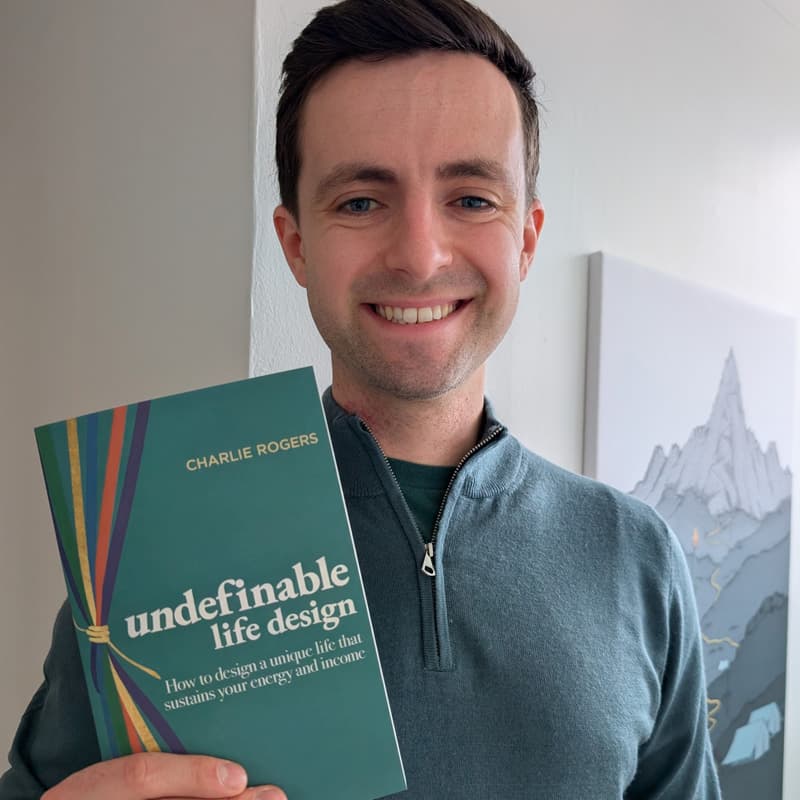
Charlie Rogers poses with his newly published book.

“If you take someone’s many interests, they can be ordered into a few broader categories. From that you can find a ‘golden thread’ that combines these in unique ways and offers the potential to develop many value streams for a portfolio-based career.”

Charlie moved to Valencia and Benicàssim to write the first full draft, then spent months developing it with feedback from a small number of close contacts at a time. The result, he says, is the most meaningful thing he’s made.

“I believe it’s the best work I’ve ever created. It’s a genuinely great piece of art that I feel can help people who might feel lost or stuck in a rut without the right kind of guidance.”

Reflecting on his twenties, Charlie highlights three principles for anyone beginning their career:

  1. Share before you’re ready

“Showcasing your perspective before you feel qualified and documenting it as learning is one of the most powerful things you can do. When I started out I was just documenting my business development, even though I didn’t have definitive answers, and that created people who are still advocates now.

“Removing ego and the fear of failure is a powerful starting point. If one person read it and thought it was useful, it was worth taking the time to do.”

  1. Take a chance on unconventional pathways

“Choosing unconventional routes earlier lets you test, experiment, and see if this kind of life is for you. It’s still fine to go back and work for someone else if that’s the best route. If what you are doing is not working, try something else, because if you try earlier you are going to learn a lot more.”

  1. Find mentors who lift you up

“Find the guide or mentor who can help you succeed. There are so many people along my journey who really helped me through mentorship. When you are young, a lot of people later in their career want to help and you can learn a lot from them.

“Above all, he believes careers should be shaped by intention rather than expectation. “I exist in a world where I made a lot of my career moves intentionally. Life shouldn’t just be something that happens to you, it’s a journey you need to approach with intentionality and consideration if you want to live to your fullest.”


undefinable life design: How to design a unique life that sustains your energy and income is available to purchase now online.