Electricity generation from solar photovolatics has been booming over the past decade, with dramatically reduced costs and concerns over climate change propelling the deployment of solar across the globe.
But despite the scale of the industry, solar photovolatics is a relatively young technology and developments to increase module efficiency and durability continue at a pace.
To support its development a new national facility for high resolution cathodoluminescence has been officially opened at Loughborough University, supported by £2.6m funding from the Engineering and Physical Sciences Research Council (EPSRC).
The new facility, based in the Loughborough Materials Characterisation Centre, enables photovoltaic devices to be examined at the nanometre scale. Attached to powerful electron microscopes, the light emitted by the interaction of the electron beam with the surface can be analysed to probe the effect of atomic scale features.
By understanding the effect of defects such as grain boundaries, the solar cells can be developed to maximise their efficiency. Use of the facility will also provide important information for the development of other optoelectronic devices such as light emitting diodes and quantum dots.
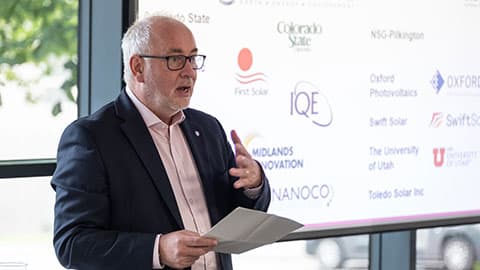
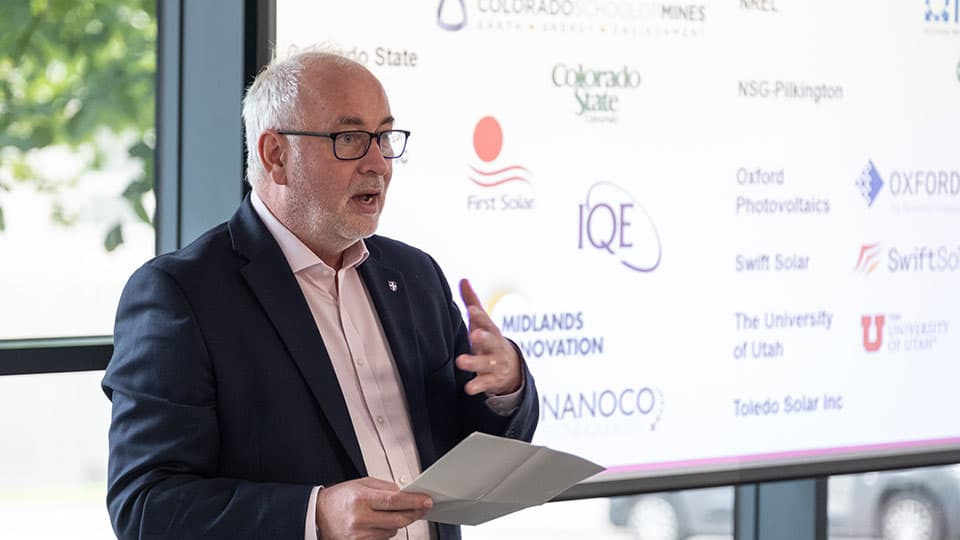
Opening the facility, Professor Jennings said: “Loughborough is proud to host this world leading facility. It will boost our own research capability and it will also be an important resource available to all UK researchers. We are also receiving significant interest from international laboratories. We want to thank our suppliers for doing a great job delivering and integrating this impressive equipment on time and on budget.”
Professor Mike Walls from University’s Centre for Renewable Energy Systems Technology (CREST) added: “Solar is quickly becoming the most important means of electricity generation world-wide. In the UK the Government has ambitions to more than double the amount of solar by 2030. This facility will enable the UK research community to play its part in improving the technology.”