Can we map The Odyssey? How ancient geographers and modern researchers have traced Odysseus’s travels

History

An opinion piece written by Professor Pragya Agarwal for the Conversation.

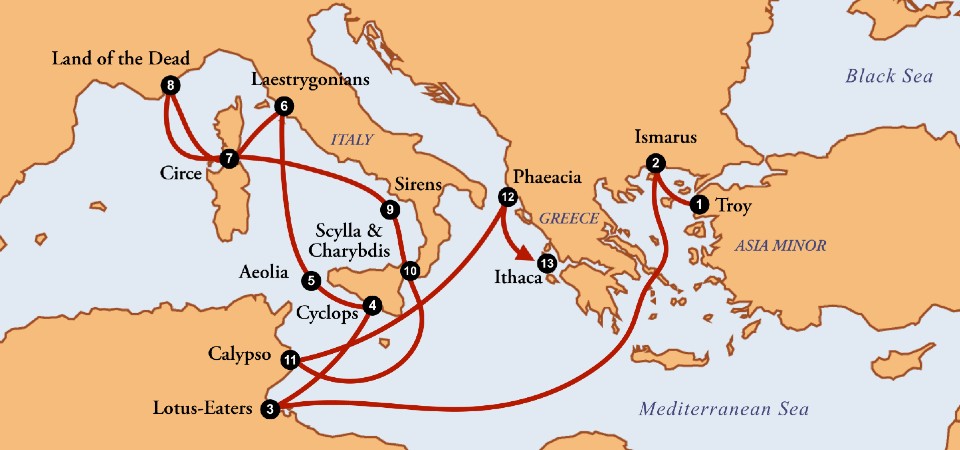
Homer’s Odyssey is a quest, following King Odysseus’s ten-year journey back home to Ithaca after the Trojan war. It is a tale with distinct geographic, spatial and temporal dimensions. It is no wonder that for centuries, people have been intrigued by the places mentioned in the Odyssey, wondering how many of them were real.

few historians and classical scholars argue that the Odyssey is only poetry. As a work of art and pure mythology, they claim, there is no point looking for these places on a map.

The ancient Greek polymath Eratosthenes, who was the first person to measure the circumference of the Earth, disputed that the Odyssey had anything to do with geography. He said: “You will find the scene of the wanderings of Odysseus when you find the cobbler who sewed up the bag of the winds.”

I have researched the history of cartography and mental mapping for more than two decades. To me, the geographical elements of this story are what grounds it. Odysseus’s desire to find a way home lies at the very heart of the poem. And Odysseus changes as he moves across these various places and spaces.

Mapping the myth

The ancient Greek historian Polybius, who came 600 years after Homer, believed The Odyssey was a real story with some myths, rather than the reverse. He insisted that some of the fishing practices near Scylla, for example, were similar to those in the islands of Sicily, so Scylla must be located off the coast of Sicily.

Continues…

The Conversation logo

For the full article, visit the Conversation.

ENDS

Press Release Reference: 26/138

Peter Warzynski

PR Manager

Tel: 01509 223491

Loughborough is one of the country’s leading universities, with an international reputation for research that matters, excellence in teaching, strong links with industry, and unrivalled achievement in sport and its underpinning academic disciplines.

It has been awarded five stars in the independent QS Stars university rating scheme and named the best university in the world for sports-related subjects in the 2026 QS World University Rankings – the tenth year running.

Loughborough has been ranked eighth in the Complete University Guide 2027 – out of 130 institutions. The achievement means Loughborough remains among a select group of universities that have maintained a top 10 position for more than 10 consecutive years, alongside Oxford, Cambridge, the London School of Economics, St Andrews, Durham and Imperial.

Loughborough was also named University of the Year for Sport in the Times and Sunday Times Good University Guide 2025 - the fourth time it has been awarded the prestigious title.

In the Research Excellence Framework (REF) 2021 over 90% of its research was rated as ‘world-leading’ or ‘internationally-excellent’. In recognition of its contribution to the sector, Loughborough has been awarded eight Queen Elizabeth Prizes for Higher and Further Education.

The Loughborough University London campus is based on the Queen Elizabeth Olympic Park and offers postgraduate and executive-level education, as well as research and enterprise opportunities. It is home to influential thought leaders, pioneering researchers and creative innovators who provide students with the highest quality of teaching and the very latest in modern thinking.