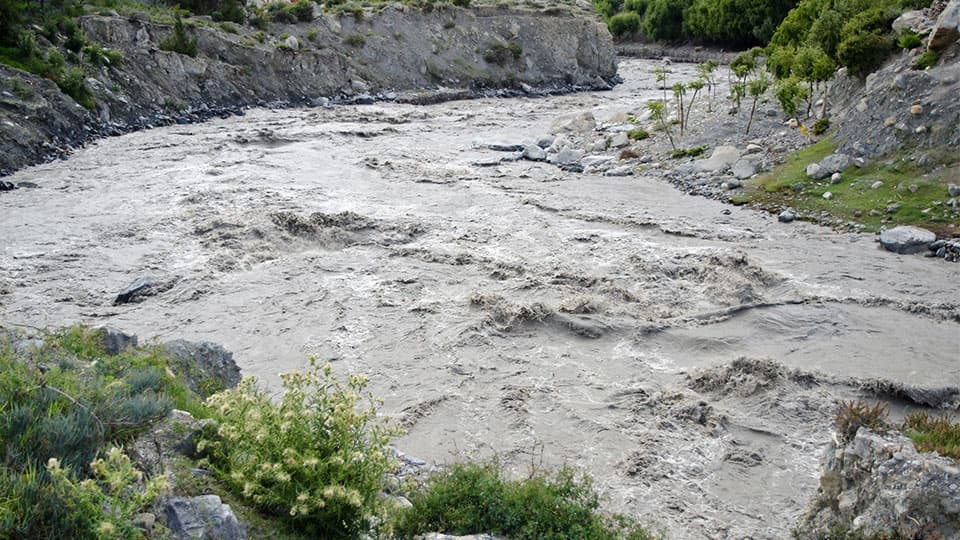
The devastating floods that have swept through the Nepal–Tibet border region are first and foremost a human tragedy. Hundreds of people have died or remain missing.
But as scientists begin to reconstruct what happened, the event also exposes something fundamental about the way we understand natural hazards in high mountain regions. Mountains and rivers do not reset after an extreme event. A landslide changes a slope. A flood rearranges a river. A retreating glacier exposes sediment and unstable ground. Each disturbance changes the conditions in which the next one occurs. In the Himalayas, those connections can turn individual hazards into destructive hazard cascades.
Early satellite and seismic evidence indicates that this disaster began high in the mountains with the collapse of part of a slope and steep glacier in Tibet. A huge mass of ice and rock travelled rapidly into the valley below, mobilising water, sediment and debris that then spread through the river system and into Nepal. The precise mechanics of the event will take time to establish. But describing it simply as a flood captures only the final stage of a much longer process.
I am involved in a UK-Indian academic project that starts from a simple proposition: hazard risk in the Himalayas is not static.
Climate change is changing how hazards interact
For instance, retreating glaciers can leave behind unstable slopes and large stores of loose sediment. Some have been described as “sediment bombs” because huge quantities of material can remain in a valley until released by another landslide, severe rainfall or a flood. The first hazard therefore changes the landscape in which the next one happens.
It would be wrong to conclude from a glacier collapse alone that climate change caused this particular disaster. Individual events require careful attribution, and steep Himalayan landscapes have always experienced landslides, avalanches and floods. But climate warming is changing the background conditions in which these processes operate: glaciers are retreating, the slopes they inadvertently support are being destabilised, new lakes are forming and large volumes of loose sediment are being exposed. Warmer air can also hold more moisture, increasing the potential for intense precipitation.
Continues...

The full article is available on The Conversation platform.