Portfolio Submission Guidance
Your portfolio is a significant part of the admissions process - while your grades signify your academic achievements, your portfolio displays your creative ability.
“A portfolio is not just about the work inside it, but about the way the work is presented and communicated as an overall narrative to best tell your story as a creative individual.”
We encourage a diverse range of work including finished and unfinished projects – we want to understand your design process, that is the making process and your reasoning behind the decisions that you have taken to make a finished product.
Portfolio name
You should comply to our Portfolio naming convention, which includes your UCAS number and name: Portfolio_UCASNumber_Initial.Surname
For example: Portfolio_123-456-789_B.Robinson
Please also include your name and UCAS number in the 1st page of your portfolio. Any other files you submit e.g. mpeg videos should also comply to our naming convention, for example:
PortfolioVideo_UCASNumber_Initial.Surname
Format
Your portfolio should have a maximum total of 15 pages including the cover page. The layout should be landscape oriented, as we will see your portfolio in the monitor screen. Please submit only a PDF file format, if we are unable to open the file, this can cause delays.
File size
Your portfolio PDF file should be maximum 200mb. You can reduce the size of your file using Adobe software or Online. If you cannot reduce the size, please let us know for an alternative way of submitting.
What to include in a portfolio?
Typical types of portfolio material:
- Sketches
- Free-hand drawings (ink, charcoal, pencil, graphite)
- Orthographic drawings (plans, sections, elevations)
- Life-drawings
- Collages
- Sculptures
- Physical models
- Time-based work (films, animations, music)
- Graphic design (flyer, logo, brochure)
- Photography
- Paintings
- Website design
- Metalwork
- Woodwork
- Textiles
- Creative writing (poetry, short story)
- Research studies (a precedent study)
- Whatever you feel conveys your creativity and imagination.
You may include pages that express your technical ability e.g. CAD drawings, however we prefer to see work that displays your creative ability in the visual and material arts.
Pieces can be from your GCSE, A-level or equivalent courses and most importantly we would like to see personal work that reflects your interests and self motivation to be creative. We do not expect to see architecture you designed, but a selection of your best work that demonstrates your creative passions and ambitions. Ask yourself, whether your portfolio itself is a piece of design work you are proud of. Some examples of our student's works are available on Instagram:
@lboroarchitecture
How to organise the portfolio
Cover [1 slide] [UCAS Number should be on the cover]
Overview/Index [1 slide]
* A Thematical Project 01, 02, … [3-4 slides]
Project showing creative process 01, 02, … [1-2 slides each]
Project showing creative process 01, 02, … [1-2 slides each]
Project showing different skills 01, 02, … [1-2 slides in total]
A side project showing extracurricular skills 01, 02, … [1-2 slides each]
Outro, Short Bio, Skills [1 slide]
TOTAL 13-15 slides.
This content is indicative, you may shape your portfolio order and decide on the number of projects individually.
What is a ‘Thematical Piece’ of work?
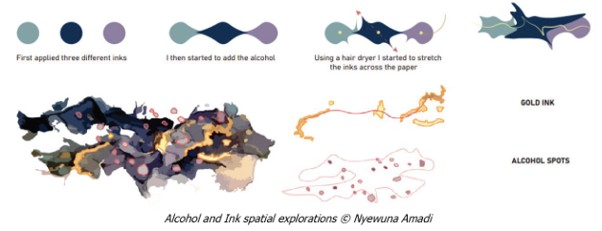
Within your .pdf portfolio, we suggest you to make a new piece of work that investigates and responds to any theme of your choice, such as the example below: Example theme of ‘Connections’: this could refer to physical connections (e.g. a plug and socket or train tracks), social connections (e.g. between parent and child) or any other (e.g. digital, environmental, metaphysical), and it does not have to be taken in an Architectural direction. Your work on such a theme should focus on showing us your ability to reflect on, analyse and creatively visualise your interpretation of the theme.
With any theme of your choice we would like to see how the exploration of the idea develops with process work and
then presentation of the final piece, all clearly labelled. The exploration of ideas should be shown first using some work generated in preparation for creating the final piece, e.g. initial sketches, initial models, other experimental work carried out prior to the final piece. Then you should present your final piece, in a carefully composed and presented manner.
Tips to consider when assembling your portfolio
- The organization of your portfolio – Is the transition between pages showing any continuity? This would not mean that you have to organise your projects chronologically, but each project should clearly display the process and the product.
- The organization of the content on a page – use the layout of the page to clearly communicate your work and the ideas and process behind it.
- Carefully consider what each piece of work may communicate about your approach to design–skills, representation (literal or abstract).
- Does your portfolio showcase a good mixture of ideas and skills (e.g. drawing, making)?
- Have you clearly cited any material that you did not create yourself?
Portfolio Evaluation Criteria
Range of Ideas
Does the portfolio demonstrate a broad range of conceptual approaches and project typologies?
Are ideas developed with depth and intellectual rigor across different scales or contexts?
Variety of Skills
What range of technical and creative skills does the portfolio evidence (design thinking, spatial reasoning, technical documentation, material exploration, etc.)? Does the candidate demonstrate proficiency across multiple modes of architectural practice or inquiry?
Visual Communication
How effectively does the candidate convey complex ideas through visual means (drawings, models, photography, diagrams)? Is the visual language clear, impactful, and well-calibrated to the content?
Labels/Narrative
Does the portfolio articulate the conceptual and methodological thinking behind each work? Is there a clear narrative thread that helps readers understand the candidate's intellectual position or design approach?
Creativity in Final Work
Does the candidate demonstrate original or unconventional thinking in their design propositions?
Is there evidence of creative risk-taking or flair in the realised or proposed outcomes?
Presentation
Is the portfolio well-organized with considered layout, hierarchy, and visual logic?
Does the overall execution (typography, spacing, material quality if printed, digital navigation if online) demonstrate professional attention to detail?