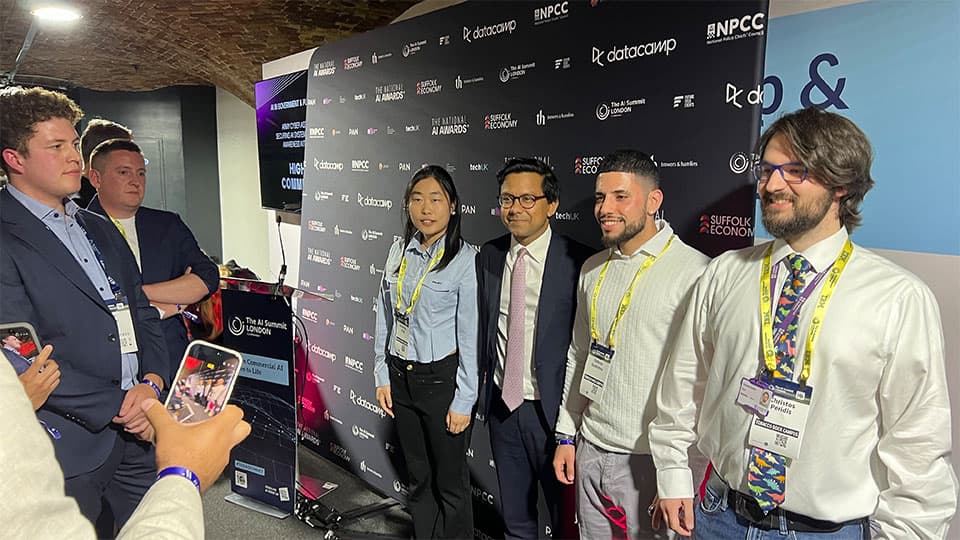
A team of Loughborough academics from the Department of Computer Science attended the NVIDIA Hack for Impact Hackathon in London from 5-7 June, with the support of the School of Science. They were selected as winners for “Best use and implementation of the NVIDIA Nemotron model”, receiving an NVIDIA graphics card as a prize.
The winning team, comprising Ruiming Xing, Petros Andreou, and Research Associate Christos Peridis and named ‘Codeborough’, developed an AI-powered “Agentic Facilities Assistant Navigator”, which is designed for real-world urban use by helping people access and understand public services. Built during the fast-paced hackathon, the system uses advanced language models to interpret user queries and provide clear, relevant information through an intuitive interface. To create the tool, the team used AI software and high-performance computing platforms provided at the event, experimenting with different models and approaches to ensure the system worked efficiently in real time.
The Loughborough team faced tough competition from reputable institutions across both academia and industry, including Imperial College London, UCL, University of Cambridge, Brunel University of London, Queen Mary University of London, King's College London, BBC, University of Leeds, Incubator for AI, and J.P. Morgan.
Ruiming Xing, speaking on the event, said:
“One of the most valuable aspects was the opportunity to work hands-on with NVIDIA's DGX Spark platform. Using such a powerful AI system to build and deploy an Agentic AI solution gave me practical experience with local AI deployment and modern reasoning models such as Nemotron. As a PhD researcher, I found it particularly inspiring to work with technologies that I had previously encountered through academic research and to see them applied to a real-world challenge. I greatly appreciated being part of such an innovative, collaborative, and inspiring experience.”
After the announcement of the winners, Tom Blake, a representative of the Department for Science, Innovation & Technology, invited the team to participate in The National AI Awards winners celebration ceremony, hosted by The AI Summit London and held at Tobacco Dock in London on 10 June. As part of the ceremony, the Minister for AI and Online Safety, Kanishka Narayan MP, introduced their project to attendees. Beyond the ceremony, the Department for Science, Innovation & Technology will support the future commercialisation of the team’s software, including technical support, resources, and mentoring.
Speaking about his team’s win and attendance at the National AI Awards, Christos Peridis said:
“I have been working very hard for nearly 10 years to be able to support this dream, in terms of my knowledge and my skills as a scientist and researcher. Achieving such a dream would not have been possible without the full support from the University that encouraged and funded us to participate. And for that I will always be very grateful!”
The hackathon, organised by NVIDIA, is an annual event that challenges participants to create innovative AI systems that can operate independently and make a positive impact in the real world. Teams are asked to build intelligent applications using advanced AI models and run them on specialised computing platforms provided at the event. NVIDIA’s aim is to push the boundaries of practical AI solutions. This year’s hackathon had three main tracks, Economic Systems, Public Services, and Urban Operations, which differ in the data used and the purpose of the application.
Petros Andreou, talking about the effectiveness of the NVIDIA as an event said:
“Attending the NVIDIA Hack for Impact in London was one of the most rewarding experiences I've had professionally. Unlike previous hackathons I attended, which were dominated by people in managerial roles, this one was filled with founders, industry practitioners, and PhD students from top universities, which made the competition feel organic and the networking genuinely valuable.”