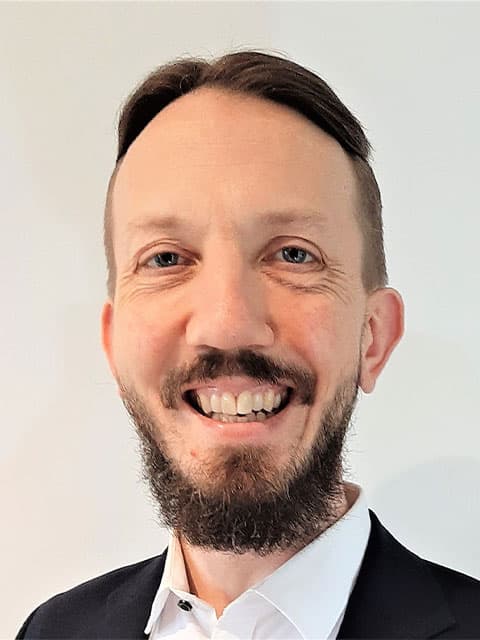
Stephen is a Systems Engineer with a vision for a harmonious, interconnected world that understands how to use technology securely & safely to break down barriers & bridge divides. Before academia, he consulted on requirements engineering for international businesses. His background is in safety-critical automotive embedded software and he has run two companies serving the multilingual needs of international engineering.
Stephen received an MEng (Dist.) in Electronic & Computer Engineering from Leeds University, with a year studying in Dortmund, Germany. He then became a software engineer in Formula 1, working on all aspects of vehicle software and was responsible for ISO 9001 TickIT, code quality & audits.
A sabbatical as a professional whitewater guide followed, before a return to software, working on early generation automated manual transmissions, an important emissions-reduction technology. Building on his automotive experience, Stephen set up a German–English translation business serving companies like Mercedes-Benz.
On his return to software engineering as a contractor to a large Chinese automaker he focused on processes & methods and took his first steps into Systems Engineering. Next he provided consultancy on multilingual requirements and discovered a love of research that led to a PhD to deepen his knowledge of Model-Based Systems Engineering and cybersecurity.
His action research with the developers of the first ISO standard for automotive cybersecurity ISO/SAE 21434 helped reshape the vocabulary and developed mappings to important related standards.
In his spare time, Stephen runs Robot Day, a volunteer-led celebration of Science, Technology, Engineering, Arts and Mathematics (STEAM). The outreach organisation provides free, hands-on activities and events to educate, inspire and inform people of all ages about robotics, automation and artificial intelligence. He also enjoys gardening, learning guitar, and playing billiard sports.
Stephen researches how global enterprises can work together using models to deliver complex, high-integrity systems that remain trustworthily secure. As a Senior RA, he focuses on dynamic assurance of systems that use quantum mechanics to ensure security. He applies ontology- and model-based systems engineering to develop architectures & tools for modern assurance.
To maintain trust in safety & security-critical networks, new ways are needed to assure them as they evolve. Stephen’s PhD (2025) presents methods to help keep road vehicles secure & safe and outputs will appear in OMG’s Multiple Vocabulary Facility specification. He actively contributes to the MVF Revision Taskforce and Technical Specification ISO/IEC TS 20499 “Conceptual framework for systems & software engineering standards compatibility”.
His work is applicable to many types of high-integrity system that must remain secure throughout their lifecycle. Dynamic, principles-based assurance for complex, high-integrity systems, a new frontier in digital assurance, is a key focus.
Loughborough Quantum Systems Engineering explores the interplay between evolving technologies and changing operational/regulatory contexts. The group’s Quantum Key Distribution assurance project adopts Principles-Based Assurance (PBA), advocated by the National Cyber Security Centre.
The challenges of this extend beyond technical issues, since applying principles rather than rules requires hands-on, brain-on engagement at senior level to determine what good looks like in context for every case. Similarly, assurance evaluation work is less straightforward and more effort to assess.
Such a transition is not undertaken lightly, but is seen as essential for the future resilience and security of highly interconnected, dynamically reconfiguring systems that cannot be assured using rigid approaches. Better understanding this transition and how it may be facilitated is an active research topic for Stephen and the group.