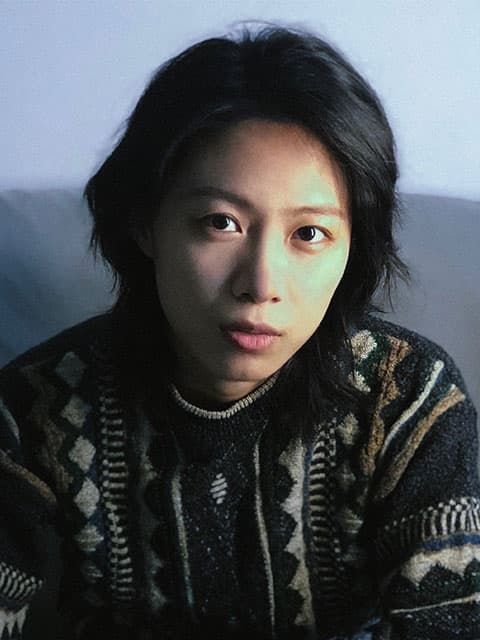
Qiyao Chen (b. 1996, Fujian, China) is a practitioner-researcher working across performance, sound, video, and site-specific installation. She holds an MFA in Experimental Art from the Central Academy of Fine Arts (CAFA) and a BFA in Sculpture from the Hubei Institute of Fine Arts (HIFA).
Qiyao treats the body and sound as metaphorical media of perception and disruption. By reconstructing everyday behaviours and amplifying sensory experience, her works generate poetic estrangements that reveal the subtle yet forceful dynamics between individuals and institutional power structures. Her practice integrates embodied performance, sonic exploration, and technological experimentation, forming a practice-based research inquiry centered on embodied action.
Her work has been presented in exhibitions including Charging Guide (Ming Contemporary Art Museum, Shanghai, 2025), The Stone of Her Mountain (Guardian Art Centre, Beijing, 2023), Groups as Methods (Central Academy of Fine Arts Art Museum, Beijing, 2023), Youth Today (798 Art Centre, Beijing, 2023), and Material Girl (China Culture Centre, Sydney, 2022). She has undertaken residencies at the Nordic Contemporary Art Centre (2023) and the Twins Museum on Cryptovoxels (2022).
Qiyao’s works are held in the collections of the Central Academy of Fine Arts Art Museum, the Twins Museum, and the Hubei Institute of Fine Arts.
Qiyao’s current research focuses on the “datafied body” and the growing entanglement between embodied experience and technological systems of measurement, surveillance, and algorithmic governance. Through performance, sound, and site-specific interventions, she examines how biometric monitoring, physiological sensing, and data extraction reshape the boundaries of agency and the conditions of being sensed.
Her work examines how embodied actions can function as forms of critical resistance within datafied environments. Drawing on posthumanist theory, surveillance capitalism, and the politics of the body, she explores the tensions between lived corporeality and machinic abstraction, proposing embodied disruption as both an aesthetic and political methodology. Building on her practice-based work, this research constitutes an integrated inquiry into how bodies negotiate power within technologically mediated landscapes.
Beyond her practice and research, Qiyao actively engages in teaching, mentorship, and art–technology collaborations. She has led workshops, mentored the queer university video art training program, and joined interdisciplinary teams exploring technologies and new materials - such as electronic-skin interfaces and UV imaging - in artistic practice. She is also deeply interested in site-specific projects and the social dynamics of public space.
As an artist with Attention Deficit Hyperactivity Disorder (ADHD), Qiyao enthusiastically participates in related activities and talks, contributing her perspective and energy to discussions on neurodiversity.