Leading Loughborough economist shares insights on Britain’s economic challenges with alumni and industry leaders

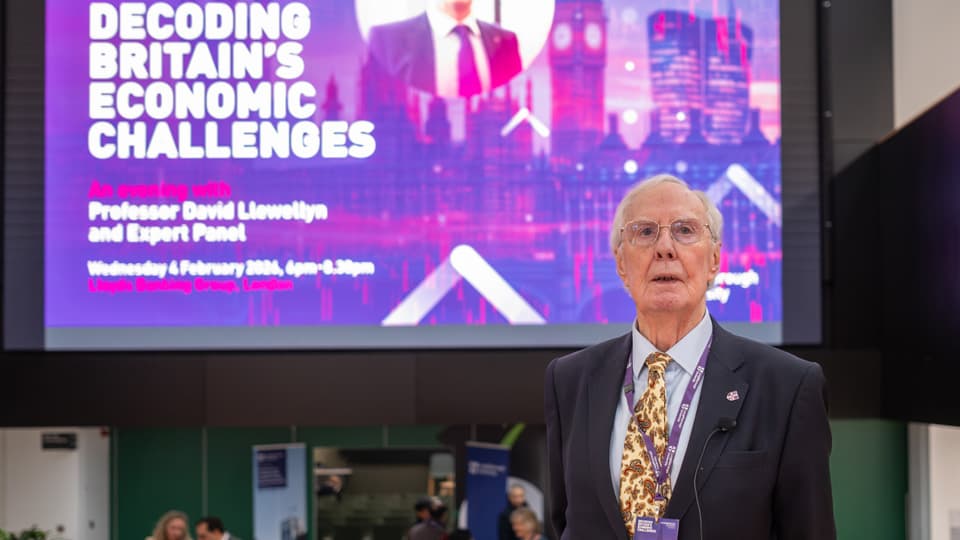
Professor David Llewellyn stands in front of a screen promoting his lecture on Britain's economy.

In a recent talk at Lloyd’s Banking Group, Emeritus Professor of Money and Banking David Llewellyn, shared the insights of his wide-ranging research into the state of the British economy.

Addressing an audience of Loughborough alumni and industry leaders from across the finance sector, Professor Llewellyn explored the serious challenges facing the economy and what measures could be taken to boost productivity.

Hosted by Loughborough alum Helen Bierton OLY (BSc Banking & Finance, 1997), Chief Digital Officer at Lloyds Banking Group, the event represented an opportunity for alumni to connect with fellow graduates, exchange ideas, and build professional relationships.

The session was introduced by Christine Hodgson CBE FCA (BSc Accounting & Financial Management, 1987), Senior Pro-Chancellor and Chair of Council. Well known for his engaging and thought-provoking lectures, Professor Llewellyn then guided the audience through an in-depth examination of the topic “Decoding Britain’s Economic Challenges”
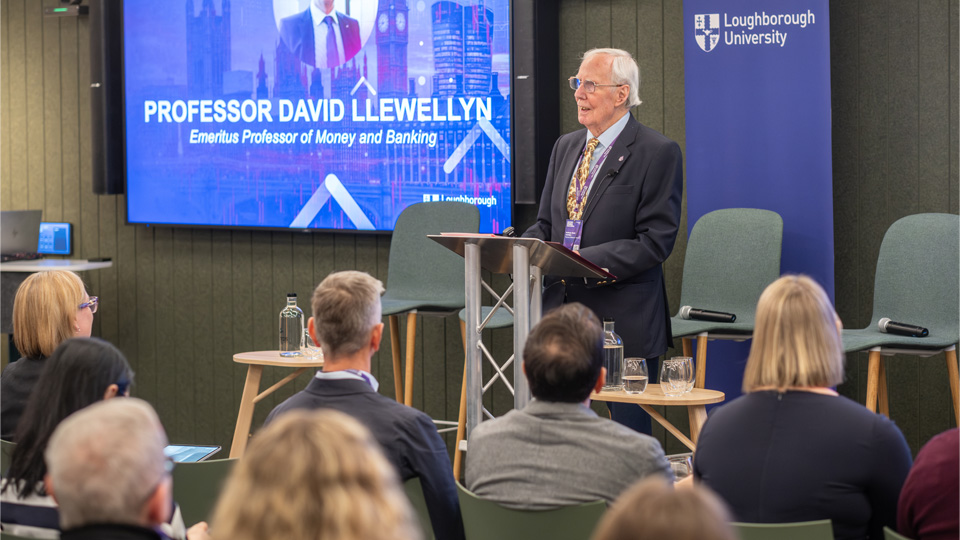

Professor David Llewellyn addresses an audience of Loughborough alumni and finance sector leaders.

Professor Llewellyn said: “I was delighted to be invited to give this lecture after hearing how many former students still enthusiastically remembered my teaching. Productivity felt like a very timely topic to discuss because it sits at the heart of every major economic challenge we face as a nation.

“For decades, Britain’s economic performance has been weak, historically and relative to other countries, and the usual explanations like low investment or poor infrastructure don’t fully answer why that is the case.

“My view is that our productivity problem stems from two deeper sources: structural issues and, crucially, culture. We don’t talk enough about how culture shapes economic behaviour. Short‑termism, high risk aversion, and a strong expectation that government will always step in with protection or compensation all act as brakes on growth.

“Contrary to what some argue, this isn’t about a lazy workforce; it’s that UK workers have less capital behind them than workers in comparable countries, so they simply can’t reach their full potential.

“Productivity matters because it creates the resources that allow society to make choices: whether that’s funding the NHS, meeting rising defence needs, or handling demographic pressures. Ultimately, economic progress will require cultural change as much as economic policy.”

A panel of four experts and host Helen Bierton OLY discuss Britain's economic challenges.

Following the conclusion of the lecture, attendees also had the opportunity to hear from an expert panel on the topic of productivity, including:

  • Richard Anthony (BSc Management Sciences, 1996), CEO of Evercore Private Funds Group
  • Luqman Niazi (BSc Electronic & Electrical Engineering, 1992), Global Managing Partner, Industries at IBM Consulting
  • Jennifer Hale (BSc Finance & Management, 2008), Partner at BDO LLP.