The event comes as the Government announces its new Road Safety Strategy, placing renewed national focus on long-term, system-wide approaches to safety. Against this backdrop, the TSRC sets out an ambitious vision: an inclusive, sustainable and human-centred transport system in which safety is designed in from the outset, rather than added as an afterthought.
Hosted at Loughborough University’s School of Design and Creative Arts, the seminar and subsequent group sessions highlighted how world-leading research in human factors, safety assurance, fitness to drive, injury prevention, technology optimisation and focus on vulnerable road user safety help deliver the aims now embedded in national policy.
Attendees at the event included officials from the Department for Transport, Transport for London, the Parliamentary Advisory Council for Transport Safety and local county authorities, all of whom will have responsibility in implementing aspects of the Road Safety Strategy. The Strategy emphasises protection for vulnerable road users and the safe integration of new technologies, through evidence-based research - principles that sit at the heart of the TSRC’s research and impact agenda.
The afternoon featured a keynote address from Ruth Purdie OBE, Chief Executive of the Road Safety Trust, who reflected on the scale of the challenge facing the UK and the importance of sustained collaboration between researchers, policymakers and practitioners if long-term casualty reduction goals are to be achieved. Ruth laid out the stark figures behind road crashes in the UK and discussed some of the root causes behind these.
Professor Andrew Morris, Director of the Centre, outlined the work of the TSRC and its new strategy, and showcased how Loughborough’s interdisciplinary expertise supports a ‘Safe System’ approach across all modes of transport. From vehicle design and automation to behaviour, infrastructure and regulation, Professor Morris emphasised that the TSRC’s work seeks to ensure that transport systems accommodate real human capabilities and limitations.
Dr Haitao He talked to the attendees about Loughborough University’s TRansport AI Innovation Centre (TRAICE), highlighting the opportunities posed by adopting artificial intelligence technologies in transport. Dr He emphasised the benefits of policymakers working with academia to ensure that the full potential of these technologies are realised in an ethical, evidence-based way.
A collaborative thinktank session followed, inviting participants from a range of organisations including The Royal Society for the Prevention of Accidents, the British Safety Council, National Highways and Road Safety GB to explore how the UK can move from policy ambition to practical delivery. Discussions focused on four themes of the road safety strategy on examples of real-world road user conflicts. Together discussions identified future opportunities to prevent collisions. Three scenario conflicts were considered by the groups, which were:
- Autonomous vehicle colliding with a pedestrian when the pedestrian has right of way
- A bus violating a stop signal to collide with a car when the bus driver is under added stress of fatigue
- An E scooter and a cyclist colliding on a cycle path (away from a road).
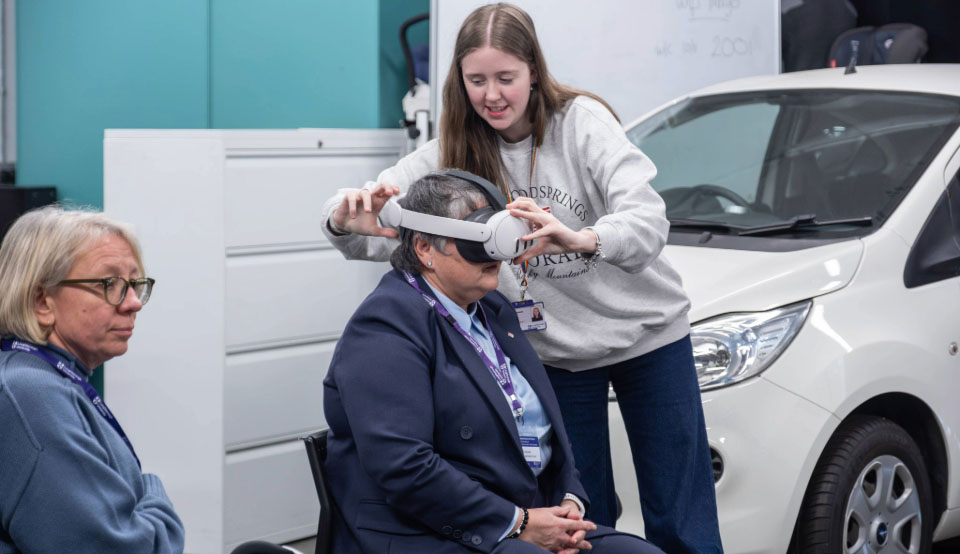
Delegates also visited the Human Factors Research Lab, where interactive driving simulator and virtual reality demonstrations showcased Loughborough’s cutting-edge research into how people perceive, respond to and interact with transport systems. These facilities underline the University’s ability to generate the kind of real-world evidence now called for in national road safety policy.
The event allowed road safety professionals working across academia, industry and policy to discuss shared challenges and opportunities, as well as open doors for future collaboration. It gave the TSRC an opportunity to discuss its ambitious plans for the future, which will make roads safer for users and result in less deaths and serious injuries.
Speaking after the event, Professor Ashleigh Filtness said: “It was a privilege for the TSRC to host such a diverse group of leading road safety voices. The UK road safety strategy has set a clear call for action, and we are ready to take that on. The thinktank was hugely successful at stimulating innovation and identifying collaborative next steps, which we will share in a full summary very soon. I am confident that the partnerships forged in the room will drive significant change for the future.”