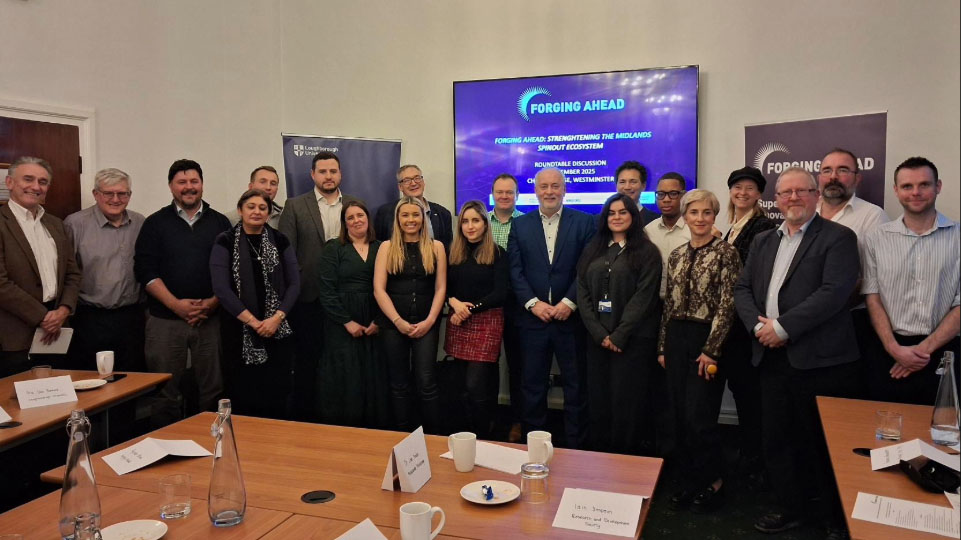
The Policy Unit recently worked with Loughborough University colleagues from Forging Ahead and Midlands Innovation to bring together senior representatives from across the region’s research, investment and enterprise landscape for a high-level roundtable to examine how to strengthen the Midlands’ role in the UK’s innovation economy.
Held on 9 December in Westminster and chaired by Loughborough’s Vice-Chancellor, Professor Nick Jennings, the session convened universities, investors, the British Business Bank, Barclays Eagle Labs, BVCA (The British Private Equity & Venture Capital Association), the Royal Academy of Engineering, regional authorities and successful spinouts.
The roundtable formed part of Forging Ahead, a collaboration of 15 Midlands universities working together to accelerate commercialisation, increase spinout success and support regional economic growth. With the Government’s Industrial Strategy placing innovation and regional productivity at the centre of its growth plans, the discussion provided a timely opportunity to shape the Midlands’ collective contribution.
Professor Nick Jennings welcomed and outlined the body of work that was growing through Midlands Mindforge and now through the new Forging Ahead Project to support commercialisation within partner universities.
At the beginning of the discussion, Dr Helen Turner, Director of Midlands Innovation set the scene with the current university commercialisation context in the Midlands. Prof Dan Parsons, Loughborough Pro Vice-Chancellor of Research and Innovation and PI for Forging Ahead, then introduced the programme and its ambition to attendees.
The agenda for the roundtable discussion focused on three major themes: unlocking capital, developing talent and commercialisation capability and creating an integrated regional innovation system.
Addressing the Midlands Investment Gap
Participants agreed that access to capital remains one of the Midlands’ biggest barriers to scaling innovation. Despite world-class research strengths, only 1% of UK venture funding has gone to Midlands spinouts since 2010, a figure that contributes to companies relocating to London, Oxford or Cambridge and overseas, for growth.
Attendees highlighted several structural challenges: limited specialist seed funds and number of angel networks, difficulties attracting major VC firms to Midlands demo days, and a persistent investment “grey zone” for med-tech companies where regulatory and clinical validation costs are high.
The group explored a range of potential solutions, including regional co-investment funds, pooled seed finance, stronger anchor-investor activity and more coordinated engagement with national and global investors. Participants emphasised that resolving the investment gap will require systemic interventions, including support from government bodies such as the British Business Bank and alignment with the new Industrial Strategy.
Strengthening Talent, Skills and Commercialisation Capabilities
Across the discussion, the most consistent theme was the central importance of talent. Investors stressed that people, not just ideas, determine whether a spinout succeeds. However, the Midlands faces shortages of experienced operators, commercial leaders and specialist technical support – challenges mirrored across the UK outside established clusters.
Key issues included limited early exposure for academic founders to entrepreneurial skills, difficulty recruiting and retaining commercialisation professionals, and fragmented access to mentors and NEDs. Participants also noted that founder equity was a growing challenge and several, therefore, called for clearer, more transparent and regionally aligned equity frameworks to reduce friction in dealmaking.
Emerging solutions discussed included a Midlands-wide founder and operator talent pool, currently being developed through Forging Ahead, shared commercialisation training across universities, strengthened regulatory and clinical support for med-tech founders, and expanded Entrepreneur-in-Residence pathways to embed commercial expertise within research teams. Participants highlighted the value of developing a consistent “Midlands founder journey” to ensure predictable, high-quality support for new ventures. Forging Ahead is taking on this challenge. Working with CRSI and the region’s university teams, Forging Ahead is developing a pipeline of ‘Commercial Champions’ to attract the commercial talent necessary for spinout businesses to thrive and grow here in the Midlands.
Building a Cohesive Midlands Innovation System
Although the Midlands has significant assets, leading universities, strong industrial partners, science parks, catapult centres and innovation strengths, participants agreed these components are not yet operating as a fully connected system. As a result, spinouts often struggle to navigate available support or leave the region in search of specialist infrastructure or investment.
Speakers emphasised the importance of developing a recognisable Midlands innovation identity, which would help attract investment, talent and strategic partners. They also emphasised the role of government in ensuring national programmes, including Research England funding, British Business Bank interventions and structures replacing LEPs, support regional strengths rather than reinforce geographic imbalances.
Forging Ahead Project and university partnerships was widely recognised as the platform with the scale and credibility to drive this integration, aligning university capabilities with investor needs and regional economic ambitions.
The roundtable highlighted both the challenges and the significant opportunities facing the Midlands as it seeks to increase its contribution to the UK’s innovation-led growth. By convening this discussion, Loughborough University and Midlands Innovation are helping to articulate a clear, collective vision for the region one that strengthens commercialisation outcomes, attracts greater investment and ensures that more Midlands-born companies scale and grow locally.
The Policy Unit will continue to support colleagues at Loughborough University and Midlands Innovation in driving the Forging Ahead Partnership Programme.