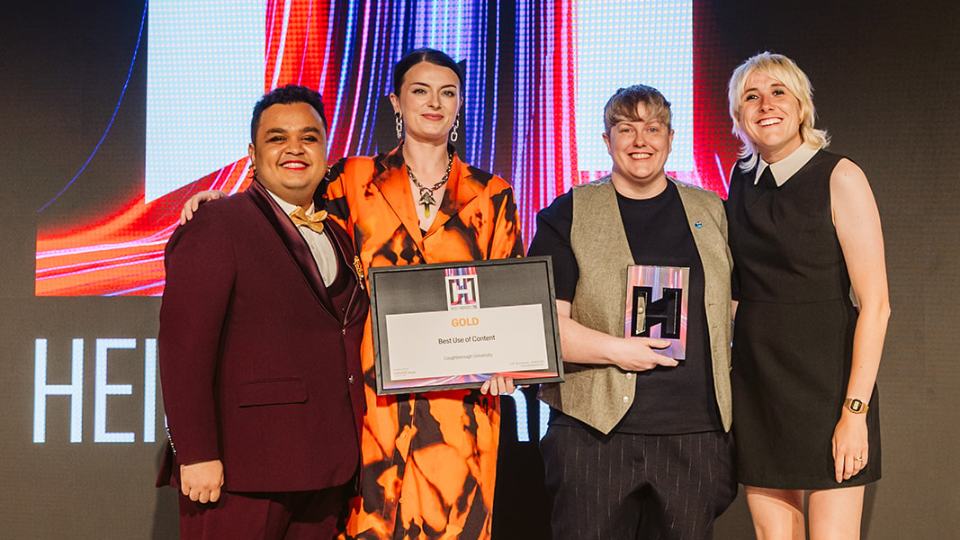
The HEIST Awards celebrate excellence and innovation in marketing across the higher and further education sectors.
PR Manager Meg Cox and PR Content Producer Hayley Evans collected the award in recognition of a campaign that transformed a complex piece of research infrastructure into a playful global science story.
"This was a stacked category with large-budget campaigns, but I was hopeful our project might be recognised because of its creativity and originality," said Meg.
"I'm thrilled it won the gold award. It's a reflection of the hard work and collaboration of multiple people and teams across the University, all of whom were willing to try something different and communicate science in a novel way."
The project began when the Department of Physics approached the University's PR team to help launch its new nanolithography system. Meg and Hayley worked closely with Head of the Department of Physics and experimental physicist Professor Kelly Morrison to develop a campaign that would showcase the technology's capabilities in an engaging and accessible way.
Recognising that the system – which will be used to develop next-generation computing components – could also pattern microscopic images onto microchips, the team proposed creating 'the world's smallest violin' as a playful nod to the well-known saying. The idea was that the miniature violin would provide the hook for the story, drawing audiences in before introducing the pioneering technology behind it and the groundbreaking research it will enable.
Professor Morrison – with support from Dr Naëmi Leo and Dr Arthur Coveney – brought the concept to life by using the nanolithography system to create an image of a violin measuring just 35 microns long and 13 microns wide (a micron is one millionth of a metre). The violin is so small that it fits within the width of a single human hair.
Meg and Hayley documented the process through a press release and video packed with creative visuals that helped audiences grasp the project's tiny scale and other hard-to-picture concepts, created with support from colleagues across the University.
Professor Paul Wood, from the Department of Geography, sourced a tardigrade – a microscopic aquatic organism used to demonstrate the violin's tiny scale. Sally Yates and Florence Millar, from the Department of Textiles, recreated the design through screen printing to illustrate the similarities between the two patterning techniques, while the Loughborough Materials Characterisation Centre helped capture a series of striking microscopic images.
The PR team secured an exclusive feature on BBC Tech Now before distributing the story internationally. The zero-budget campaign went on to generate more than 220 pieces of media coverage across 17 countries.
The story was translated into multiple languages, featured by children's science news outlets and shared across QI's social media channels, among many other notable examples of its global reach.
The campaign's success also relied on the willingness of the academics to engage with the media. Professor Morrison gave numerous interviews across broadcast, print and online outlets, skilfully explaining not only the 'world's smallest violin' but also the wider research opportunities the nanolithography system will unlock. Her engaging interviews helped bring topics such as spintronics and next-generation computing to mainstream audiences, including BBC radio. Dr Naëmi Leo also supported the campaign through media interviews, helping to communicate the significance of the research to a wide range of audiences.
The HEIST judges deemed the project “a standout content entry”.
They commented: “Loughborough University took what could have been a niche research infrastructure announcement and turned it into a genuinely memorable, accessible and globally shareable science story.”
Hayley said receiving the gold award was the “cherry on the cake” for the successful project.
She said: “This project gave us a fantastic opportunity to combine a powerful story with creative visuals, music, and emotion, to create truly meaningful narrative. For me, the most rewarding part of filmmaking is helping bring human stories to audiences in a way that resonates, creates impact, and leaves people wanting to learn more, long after the film has ended.”
Read more about the 'World's Smallest Violin' project in the press release and watch the video below.
The University’s social media team also helped the story resonate with students by creating a TikTok centred on exam season, using the violin to humorously tease the common complaints that accompany it. Watch that here.