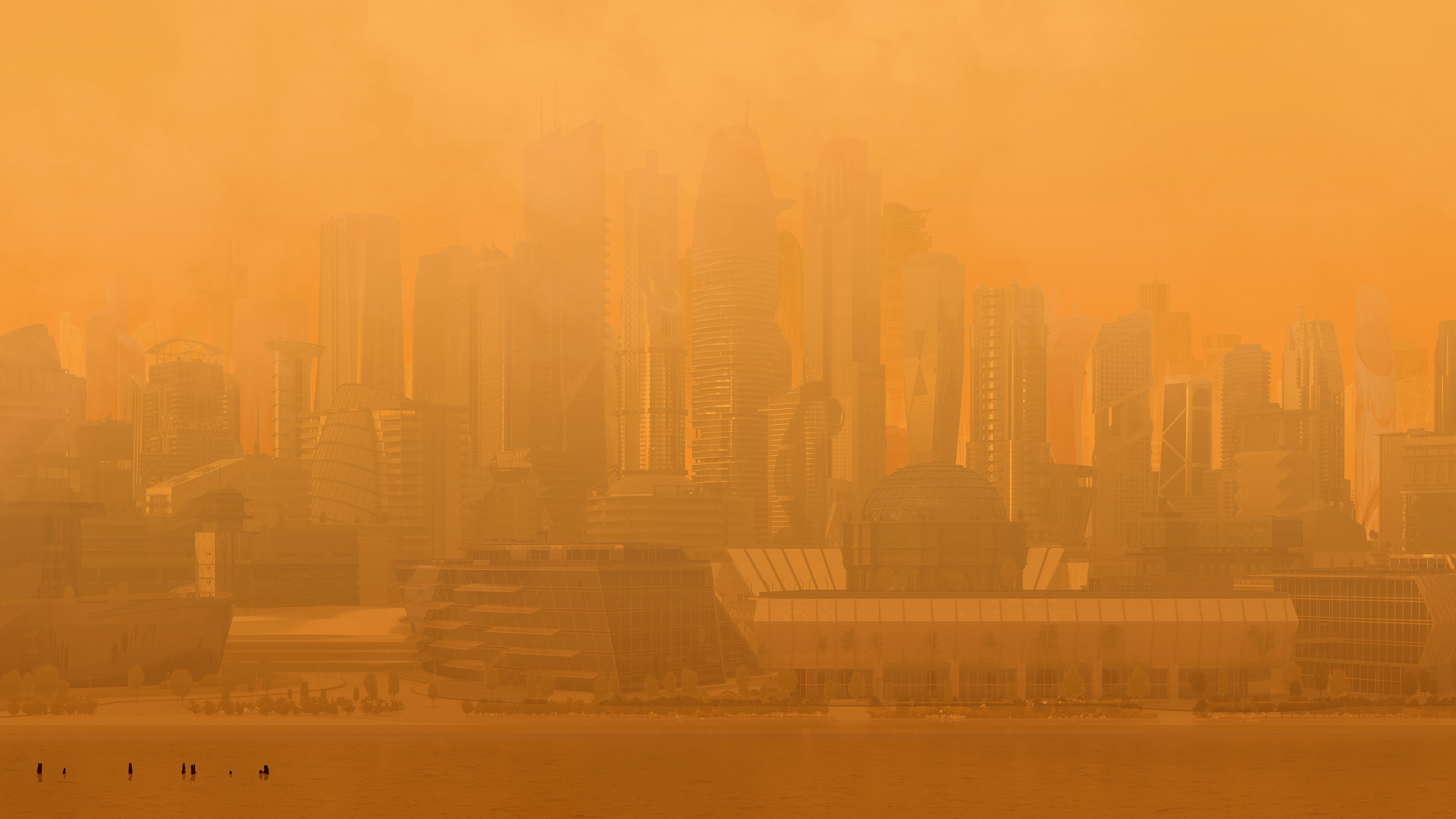
Storms of dust and sand are another sign our climate is changing. Two experts explain.

Conversation
sandstorm across a city skyline
Image credit: Getty Images

An opinion piece written by Isabelle Finlay, PhD candidate, from the School of Social Sciences and Humanities at Loughborough University, for the Conversation, with Tegan Clark, PhD Candidate, College of Systems and Society, Australian National University.

Imagine you wake up one morning and look out your window. You see a sky of red, hear a ferocious blast of wind and watch as tree branches creak and crack.

No, the apocalypse has not descended on your local neighbourhood. You’ve just been caught in the middle of a dust storm.

These storms form when strong winds lift sand and dust particles into the atmosphere. Of the two, sand storms typically occur closer to the ground and travel shorter distances. Finer dust particles can be lifted high into the atmosphere and travel across oceans and continents. Dust from Australia has been found as far away as Antarctica.

Sand and dust storms typically occur in arid environments where the ground is dry, loose and vegetation-free. But they can inflict severe and lasting damage on homes and buildings, solar panels and farm machinery. And as our planet rapidly warms, sand and dust storms will become more common.

So what does this mean for arid nations like Australia? And what can we do about it?

Where the dust blows…

In Australia, our dust storms mainly come from the vast, dry region of the Lake Eyre Basin in central and outback Australia.

Kati Thanda-Lake Eyre and Mudna-Lake Frome are two ephemeral lakes from this region that periodically flood and then dry out. This process brings new sediment that, when the water disappears, dries out and can then be lifted up by strong winds. Dust storms also form in South Australia’s semi-arid regions and the intensively farmed areas of Victoria and western New South Wales.

In Australia, dust storms travel across two main paths: from the Lake Eyre Basin across south-east Australia, and from central Australia out to Western Australia. However, recent evidence suggests there’s a third, largely unrecognised dust pathway stretching from the Lake Eyre Basin into northern Queensland and northern Australia.

Continues . . .

The Conversation logo

For the full article visit the Conversation.

ENDS


Press Release Reference: 26/177

Lynsey Heap

External Communications Manager

Tel: 01509 222226

Loughborough is one of the country’s leading universities, with an international reputation for research that matters, excellence in teaching, strong links with industry, and unrivalled achievement in sport and its underpinning academic disciplines. 

It has been awarded five stars in the independent QS Stars university rating scheme and named the best university in the world for sports-related subjects in the 2026 QS World University Rankings – the tenth year running. 

Loughborough has been ranked eighth in the Complete University Guide 2027 – out of 130 institutions. The achievement means Loughborough remains among a select group of universities that have maintained a top 10 position for more than 10 consecutive years, alongside Oxford, Cambridge, the London School of Economics, St Andrews, Durham and Imperial.

Loughborough was also named University of the Year for Sport in the Times and Sunday Times Good University Guide 2025 - the fourth time it has been awarded the prestigious title. 

In the Research Excellence Framework (REF) 2021 over 90% of its research was rated as ‘world-leading’ or ‘internationally-excellent’. In recognition of its contribution to the sector, Loughborough has been awarded eight Queen Elizabeth Prizes for Higher and Further Education. 

The Loughborough University London campus is based on the Queen Elizabeth Olympic Park and offers postgraduate and executive-level education, as well as research and enterprise opportunities. It is home to influential thought leaders, pioneering researchers and creative innovators who provide students with the highest quality of teaching and the very latest in modern thinking.