Driver sleepiness contributes to a substantial proportion of road crashes. Drivers who begin to feel drowsy are often advised to stop, have a caffeinated drink and take a 15-minute nap – a combination known as a "caffeine nap". It is designed to allow caffeine to take effect while the driver sleeps, helping them feel more alert when they wake up.
However, previous research supporting this advice has largely focused on the general population rather than people with OSA – the world's most common sleep disorder, affecting an estimated one billion people globally. The condition causes repeated interruptions to breathing during sleep, which can affect both health and daytime alertness.
“Despite its prevalence, all previous research investigating how people manage driver sleepiness and evaluating methods to reduce sleepiness were conducted with participants without OSA”, said study lead Professor Ashleigh Filtness, of Loughborough University's Transport Safety Research Centre.
“We wanted to ensure the advice for people with obstructive sleep apnoea is based on evidence from people like them.”
The study, funded by The Road Safety Trust, involved 21 drivers with OSA who were receiving continuous positive airway pressure (CPAP) treatment – the most common treatment for the condition which uses a mask to keep the airway open during sleep.
Participants completed a series of driving simulator sessions after their sleep had been restricted to four hours. This duration was chosen because four hours of CPAP use per night is commonly used as the threshold for someone to be considered compliant with their prescribed treatment.
Loughborough University's driving simulator. Participants completed a series of driving simulator sessions as part of the study; the footage shown is illustrative and not from the experiments reported in the paper.
Researchers compared the effects of different amounts of caffeine, different nap lengths and caffeine naps on alertness and driving performance. To assess sleepiness, they monitored participants' brain activity, eye movements and driving behaviour.
The team, who have published their findings in Nature’s Scientific Reports, found that two coffees significantly improved alertness and reduced driving errors compared with one.
The researchers observed no additional benefit from extending a nap from 15 to 30 minutes and modest improvements when a nap was added to two coffees.
“The real-world higher consumption of caffeine in OSA drivers may explain why our study found two coffees to be most beneficial”, explained Professor Fitlness.
“Although we found that two coffees provided the greatest improvement in alertness, we would still encourage drivers to take a 15-minute nap if it is safe and practical to do so as there was some benefit for some people.
“However, all countermeasures are temporary and cannot replace a good night of sleep before driving.”
The researchers also found that participants showed signs of impaired driving after just four hours of sleep, which, they say, highlights that CPAP treatment compliance does not necessarily mean a person has had enough sleep to drive safely.
"It is important not to confuse being compliant with CPAP treatment with having had enough sleep to drive safely," said Professor Filtness.
“People with treated OSA were safe to drive when alert, but following sleep restriction to four hours, driving impairment was exhibited. OSA patients are encouraged to get as long a sleep as possible with CPAP and continue sleeping without CPAP if necessary.”
To help translate the findings into practical guidance, the researchers have created an animated video (featured above) and infographic explaining what drivers with obstructive sleep apnoea should do if they become sleepy while driving.
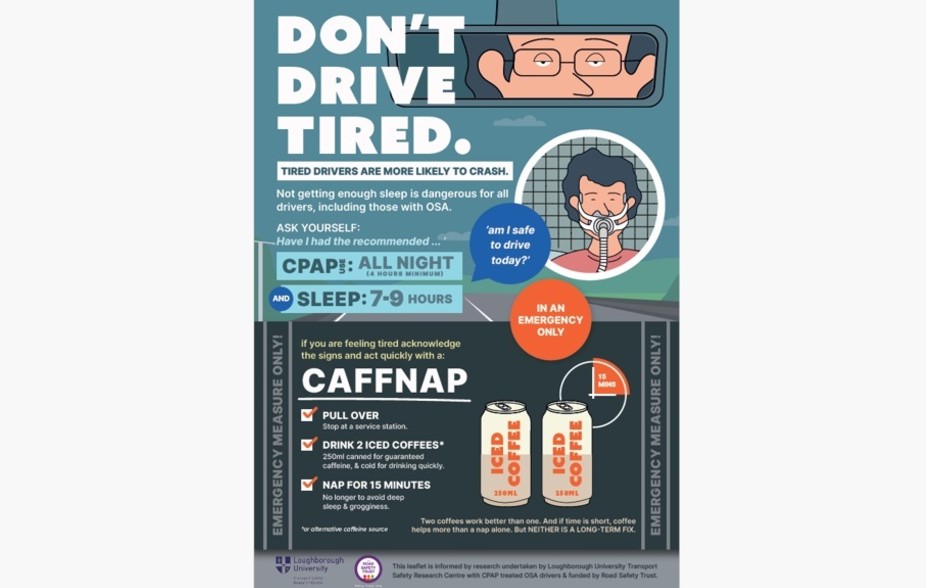 The infographic outlines the researchers' recommended response to driver sleepiness in people with obstructive sleep apnoea. Download it here.
The advice is:
- Pull over at a service station
- Drink two iced coffees or an alternative caffeine source (250ml canned iced coffee is recommended because it provides a consistent caffeine dose and can be consumed quickly)
- Then nap for 15 minutes
- If time is short, consume two coffees and skip the nap.
Professor Filtness is now working with clinicians, charities and road safety organisations – including the Road Safety Trust - to share the findings and improve guidance for people living with OSA.
Paul Steinberg, Deputy Chief Executive at The Road Safety Trust, said: “Funding research such as the Caffeine Nap study helps uncover hidden risks on our roads and provides practical, evidence-based solutions which could prevent death and serious injury.
“We know that driver fatigue and drowsiness reduces concentration, impairs reaction times and can have very serious consequences. While a good night’s sleep is always the best preparation before driving, that is not always possible for people living with certain medical conditions or because of particular circumstances.
“Professor Filtness and her team at Loughborough University have produced important new evidence and advice for drivers with obstructive sleep apnoea.
“By supporting both research and practical guidance, the Trust is proud to fund projects which can help people make safer decisions to reduce risk on our roads.”
The Loughborough researchers are hoping to build on the research by carrying out further studies into napping in vehicles to better understand how restorative sleep can be achieved during breaks.
The final project report can be found on the Road Safety Trust website.