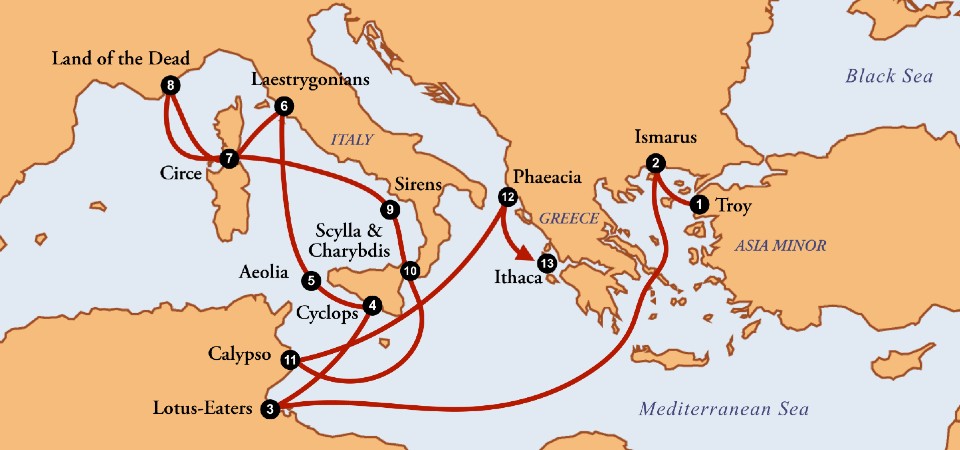
Homer’s Odyssey is a quest, following King Odysseus’s ten-year journey back home to Ithaca after the Trojan war. It is a tale with distinct geographic, spatial and temporal dimensions. It is no wonder that for centuries, people have been intrigued by the places mentioned in the Odyssey, wondering how many of them were real.
A few historians and classical scholars argue that the Odyssey is only poetry. As a work of art and pure mythology, they claim, there is no point looking for these places on a map.
The ancient Greek polymath Eratosthenes, who was the first person to measure the circumference of the Earth, disputed that the Odyssey had anything to do with geography. He said: “You will find the scene of the wanderings of Odysseus when you find the cobbler who sewed up the bag of the winds.”
I have researched the history of cartography and mental mapping for more than two decades. To me, the geographical elements of this story are what grounds it. Odysseus’s desire to find a way home lies at the very heart of the poem. And Odysseus changes as he moves across these various places and spaces.
Mapping the myth
The ancient Greek historian Polybius, who came 600 years after Homer, believed The Odyssey was a real story with some myths, rather than the reverse. He insisted that some of the fishing practices near Scylla, for example, were similar to those in the islands of Sicily, so Scylla must be located off the coast of Sicily.
Continues…

For the full article, visit the Conversation.
ENDS