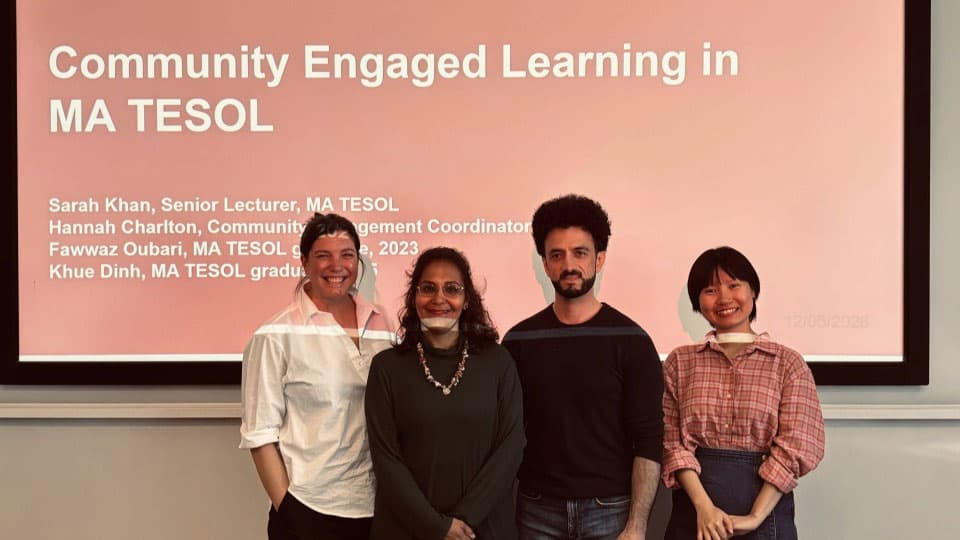
What is Community Engaged Learning?
Community Engaged Learning is a pedagogically informed approach to module design that embeds community-based projects directly into student learning. Rather than basing study activities around hypothetical, university-designed scenarios, students are provided with opportunities to connect with external partners to address genuine, community-identified needs.
Importantly, CEL is distinct from volunteering. CEL’s primary purpose is educational: students apply academic knowledge in authentic contexts whilst reflecting critically on how their learning has been applied, whilst simultaneously providing communities with meaningful value that advances their local priorities.
CEL was inspired by long-standing activities in other countries such as the US, South Africa and Ireland, whose higher education institutions are deeply intertwined with civic missions to improve local community through dedicated funding structures and long-standing partnerships.
CEL at NTU
Over the past seven years, CEL has become a cornerstone for its teaching practice and community partnerships. Projects are co-ordinated centrally and with input from all key stakeholder, with the design phase asking the key question: “What can students’ knowledge do in practice?”
Successful CEL projects create shared value for all parties involved:
- Students gain hands-on, applied learning experiences
- Academics enrich their teaching through real-world context
- Community organisations receive valuable input and support
Case Study: MA TESOL Programme
Under the spotlight of the lecture’s discussion was NTU’s MA Teaching English to Students of Other Languages (TESOL) programme, which integrates CEL into its teaching practice. The course attracts a diverse cohort of home and international students with varying levels of teaching experience, with the programme combining theoretical learning with practical teaching experience in community settings.
Prior to CEL, practical experience for students was offered via volunteering pathways, though only a handful of students engaged with these opportunities. By embedding these experiences into the course, students were able to engage in structured, supported teaching with local learners, including individuals from refugee and migrant backgrounds.
Impact and Benefits
For students, CEL provides:
- Opportunities to apply theory in authentic teaching environments
- Increased confidence and adaptability in professional practice
- Greater awareness of cultural, linguistic, and social differences
- Development of reflective and critical thinking skills
For staff, CEL offers:
- Insight into student development in real-world contexts
- Opportunities to connect teaching with community impact
- A rewarding and engaging teaching experience
For community partners, benefits include:
- Access to tailored support and educational provision
- Stronger relationships with the university
- A sense of community and shared purpose
Students and tutors noted the importance of flexibility when working in dynamic, real-world settings: adapting to unexpected situations, responding to learner needs, and developing more inclusive and communicative teaching approaches.
Student Experiences
Students shared powerful reflections on their journeys through CEL. For many, it was initially a challenging but transformative experience that shaped both their academic work and future careers.
MA TESOL graduate Fawwaz Oubari described the opportunity as a chance to not only deepen his theoretical understanding for his dissertation but also build his confidence to engage with language learners from a vast range of cultural backgrounds. MA TESOL graduate Khue Dinh highlighted how teaching in an unfamiliar setting improved her ability to adapt her teaching methods to respond to diverse learner needs. Both graduates noted how the experiences also led to increased understanding and empathy for the refugees and sanctuary seekers they engaged with and were inspired by the stories and experiences shared.
Malcolm Cook, dean of the School of Architecture, Building and Civil Engineering and chair of LUSARG said: “NTU's Community Engaged Learning is a fantastic initiative that showcases the enormous positive impact that universities can have on communities, and vice-versa. Loughborough University is deeply committed to its civic duties and supporting its local community, so hearing about CEL has sparked further ideas in deepening our relationships and delivering further impact in the local area.
“I’d like to thank Hannah Charlton and Sarah Khan for delivering a fantastic and thought-provoking presentation and thank Fawwaz Oubari and Khue Dinh for sharing their experiences on the ground delivering positive outcomes for refugees and asylum seekers.”
Overall, the session reinforced the value of Community Engaged Learning as a model for bridging academic study and societal impact. By prioritising collaboration, reflection, and real-world application, CEL not only enhances student learning but also strengthens the university’s role within its wider community.