From Science to Strategy: Exploring New Career Paths Through DInC
Seeking to understand how doctoral research skills translate beyond academia; chemical engineering researcher Yalini Sadasivam joined the LURA Doctoral Innovation Consultants (DInC) programme to gain hands-on experience of consultancy and industry. Through working with real businesses on live projects, she developed commercial awareness, strengthened her problem-solving skills and discovered a new career path that combines science, technology and business.

Yalini Sadasivam
PhD Discipline:
Chemical engineering, researching biosurfactants derived from plant-based materials for applications in cosmetics and foods industries.
Research Stage:
At the time of the programme, Yalini was in the final year of her PhD.
Organisations Worked with Through DInC:
FUSE4Performance LTD, R3V Tech LTD, Cromerix LTD
Motivations for Joining the Programme
As she approached the final stages of her doctorate, Yalini began thinking seriously about her next career step. While she knew she wanted to pursue opportunities outside academia, she was unsure whether consultancy would be the right fit.
Although she had some entrepreneurial experience from running a startup during her undergraduate studies, she had no previous consultancy experience. The DInC programme offered her a unique opportunity to gain first-hand experience to consultancy while working on genuine business challenges. She was particularly interested in understanding how the analytical and research skills developed during a PhD could be applied within a commercial environment and whether consultancy offered a route that aligned with her interests and strengths.
Working as a Doctoral Innovation Consultant
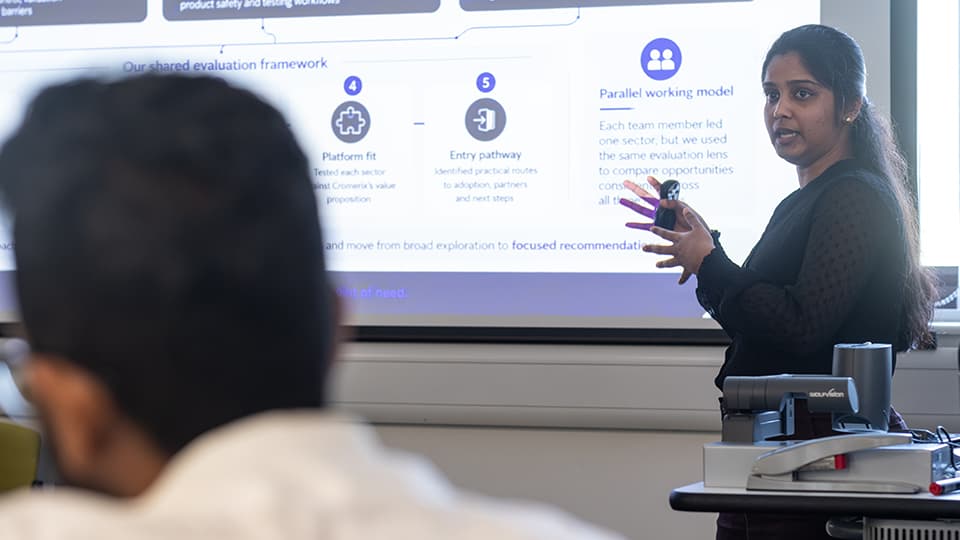
During the programme, Yalini worked simultaneously across three consultancy projects, supporting businesses operating in very different sectors. Balancing multiple projects while completing the final stages of her PhD provided an opportunity to enhance her organisational prioritisation and time management skills, while gaining practical experience of working on diverse business challenges.
The varied nature of the projects also pushed her beyond her technical comfort zone, requiring her to quickly grasp unfamiliar technologies and sectors and develop evidence-based recommendations. Working on projects where commercial sensitivities restricted access to certain information helped her to strengthen her ability to ask the right questions, refine her investigations, and navigate new challenges.
Key Learning Moments and Skills Developed
One of Yalini’s key learning moments was recognising that strong research and technical analysis must be aligned with commercial objectives to create value for a business. The programme also strengthened her ability to structure ambiguous problems, prioritise the most important questions and develop practical recommendations. At the same time, it reinforced the transferability of her doctoral skills, with her experience in research and analysis enabling her to quickly understand unfamiliar industries and deliver insight-driven solutions.
Collaboration was equally important. Working in multidisciplinary teams exposed her to different perspectives and highlighted the need to balance technical and commercial priorities. One project, in particular, highlighted the value of clear communication and coordination when differing recommendations emerged, reinforcing these as critical skills for effective consultancy.
DInC was definitely different because it was not something that you learn through theory … DInC definitely created that level of difference and responsibility because we were working with real businesses and not just imaginary cases. It provided better exposure and skills were definitely developed."
Outcomes and Reflections
Yalini described the programme as particularly valuable for doctoral researchers who want to better understand how their skills can be applied outside academia and gain practical experience of working with industry.
The DInC programme broadened Yalini’s understanding of opportunities beyond academia and gave her first-hand experience of applying her research expertise in a commercial environment. Through working with businesses on real consultancy projects, she gained a deeper appreciation of how science, technology and business intersect to create value.
Reflecting on the programme, Yalini described the experience as instrumental in shaping her future career aspirations. What began as an opportunity to explore consultancy helped her identify it as a genuine career path, while also increasing her confidence to work beyond the boundaries of her research specialism.