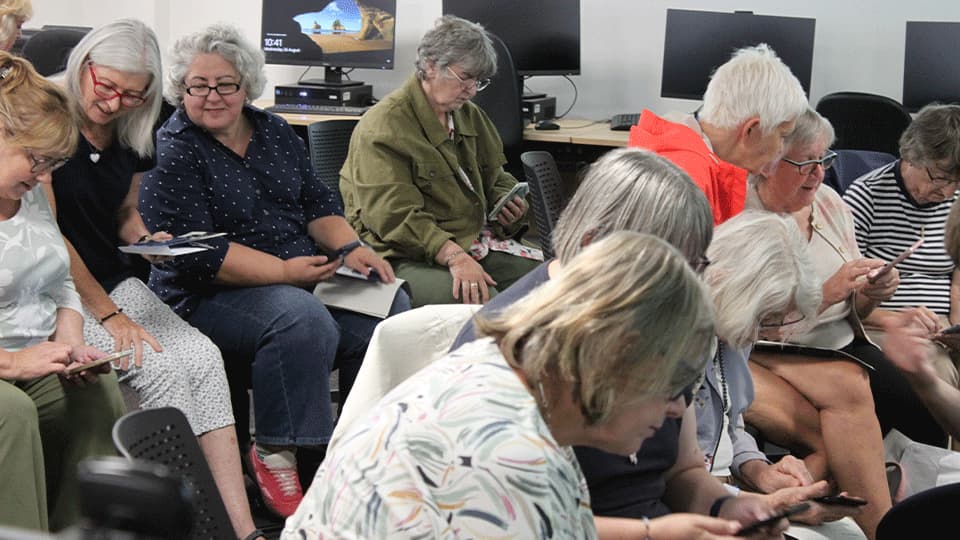
The two-day Digital Confidence and AI for Everyday Life workshop, held on 19 and 26 August, welcomed around 25 members of Normanton on Soar Women’s Institute on each day. The programme was designed to help participants build confidence using their smartphones, learn practical digital skills and understand how AI can be used safely and responsibly in everyday life.
The workshops were delivered by a wider team from Loughborough University’s Centre for AI in Education (CAIED), including Dr Sara Saravi, Dr Firat Batmaz, Dr Yanning Yang and Dr Gary Storey, with support from undergraduate student helpers, including Areej Akhtar, Ronnie Gohel, Bartek Czajkowski, Keiran Barnes—Davin and Charles Payne. Before the sessions began, members of the team met with Fran Dimelow, President of Normanton on Soar WI, to understand what members wanted to learn and tailor the workshop content to their needs.
Rather than using computers, participants worked on their own mobile phones throughout the workshops, ensuring that the skills they developed could be easily applied after the sessions ended.
The programme covered four key areas:
- Mobile phone essentials, including operating systems, Wi-Fi, apps and security.
- Digital confidence and online safety.
- Introduction to AI tools and how to interact with them using text and voice.
- Creative uses of AI with images, including photo analysis, restoration and storytelling.
The workshops focused on practical applications, helping participants understand how digital tools and AI can support everyday tasks while highlighting the importance of privacy, security and responsible use.
One of the most popular activities invited participants to bring along old family photographs. Using AI tools, members restored and colourised historical photographs before sharing the stories and memories connected to them. They then used AI to transform those memories into short stories, poems and even songs. The activity encouraged participants to reflect on family histories and personal experiences, as technology became meaningful not because of its technical capabilities but because it helped them reconnect with treasured memories. Many participants were so inspired by the experience that they planned to share their new skills with children and grandchildren, demonstrating how digital confidence can create connections across generations.
Feedback from attendees was overwhelmingly positive, with discussions about the workshops continuing beyond the sessions themselves and members eager to share what they had learned and explore further uses for AI technology.
Fran Dimelow reported: “The members of Normanton on Soar WI have now been given a new input of energy”. The success of the workshops has also sparked wider interest, with a local Men’s Association approaching the team to discuss similar sessions, while conversations with other WI branches interested in participating.
The initiative forms part of a broader programme of community engagement involving CAIED and colleagues across the University. Since last year, the team has delivered a number of workshops with local community groups, exploring practical uses of AI and digital technologies. These have included an AI and podcasting workshop delivered with Dr Rob Harland and Loughborough town library volunteers involved in the TOWN Observatory project. Participants learned how to use AI and podcasting tools before creating audio content exploring the stories behind Loughborough’s Art Deco buildings. Activities such as these support digital inclusion while creating opportunities for local communities to engage directly with the University, its staff and students.
The workshops have already inspired members of the WI to create podcasts that capture women’s experiences across different generations, covering topics such as childhood, education, working life, marriage, motherhood, later life and involvement in the WI. Among the stories they hope to preserve are wartime diaries passed down through families and accounts of local history that might otherwise be lost.
Dr Firat Batmaz, Lead of CAIED, Computer Science academic and workshop leader, said:
“What stood out for me was how quickly confidence grew once the technology was connected to something personally meaningful. Seeing participants use their own family photographs to create stories, poems and songs showed that AI can become much more approachable when people can see a clear purpose for it.”
Dr Sara Saravi, Deputy Lead of CAIED, Computer Science academic and workshop leader, added:
“We didn’t want the workshop simply to explain AI. We wanted the participants to leave knowing that they could actually use it themselves, safely and confidently, on the phone they already carry with them every day.”
CAIED hopes to continue supporting participants in developing the digital and AI skills needed to turn these ideas into reality.