The research partnership has improved healthcare for more than 1.6 million people after a number of large-scale systemic overhauls such as connecting 200 regional healthcare facilities to a centralised call centre – an increase from just 10 in 2024.
Led by Dr Albert Attom, from Loughborough University's Business School, Ho Teaching Hospital, in Ghana's Volta Region, the project has also enabled 100% of staff to access Ghana's Health Information Management System (GHIMS).
It improved the way medicines and medical supplies are managed, enabled staff to monitor bed availability in real time and made it easier for healthcare professionals to share information across the hospital and wider health service.
At the time of the report, the country’s President John Dramani Mahama said: “International partnerships with key stakeholders, including academic institutions like Loughborough University, are vital in achieving sustainable development and shared prosperity.”
At the heart of building a vibrant economy and a resilient society is the spirit of collaboration.
We recognise that international partnerships with key stakeholders, including academic institutions like Loughborough University, are vital in achieving sustainable development and shared prosperity.
Rather than simply studying healthcare systems, Loughborough researchers worked alongside clinicians, managers and policymakers to design the policy, train staff and help put the changes into practice.
Dr Attom said: “Our aim was never simply to introduce new technology. It was to help healthcare professionals spend less time dealing with administrative processes and more time caring for patients.
“Underpinned by my philosophy of impact research, which recognises that meaningful and sustainable change is achieved through interconnectivity, we've combined research, policy development, and training to help build the foundations for a healthcare system that is more connected, more efficient, and better equipped to meet the needs of the people it serves.”
A 2026 implementation review says that the partnership has delivered impact “beyond academia”, strengthening workforce capability, improving organisational efficiency and enhancing patient care.
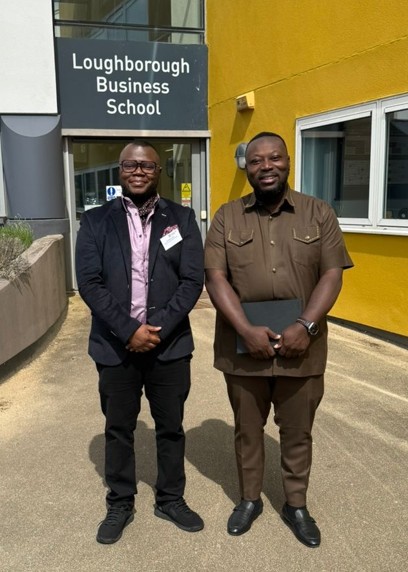
During a visit to Loughborough University in 2025, the Minister for Youth Development and Empowerment in Ghana George Opare Addo explained the importance of the collaboration with Dr Attom.
He said: “As part of my work and interacting with young people, we came across Dr Attom who was also working in skills development and research, looking at what they can do to support and develop young people.
“Our interactions with (Dr Attom) led to some of the policies we campaigned on.”
He added: “His work influenced some of the policies we are currently implementing.
“For example, we launched the National Apprenticeship Programme to bridge that skills gap, so people have sustainable skills they can use to get jobs.
“We've also started a programme called ‘Nu Ma Business’ (Youth in Business), for young people trying entrepreneurship – again, a result of some of that research.
“That's what has influenced what we are doing across government.”
Simon Yao Dzokoto, Director of Research, Policy Planning, Monitoring and Evaluation at Ho Teaching Hospital, said: “In my view, many of these developments would not have occurred in the same way or within the same timeframe without the support, expertise and engagement provided by Dr Albert Attom and Loughborough University.
“The collaboration has provided practical knowledge, evidence-based guidance and capacity-building opportunities that continue to benefit managers, healthcare professionals and patients across the organisation.”
The hospital's Chief Executive also credited the partnership with helping establish the hospital's first Healthcare Digitalisation Policy, describing it as “a major strategic milestone” that continues to guide investment in technology and service improvement.
Worlase Dotse, a Nurse Specialist in Emergency Care, said: “The combination of participating in the research, contributing to policy development and undertaking the training has changed the way I work.
“I have observed positive changes through improved access to patient information, better communication between departments and more efficient processes.
“These developments have helped improve the quality of care provided to patients and supported more timely decision-making.”
The report concludes that while further work remains in areas including telemedicine, electronic prescribing and artificial intelligence, Ho Teaching Hospital has established the foundations needed to support long-term improvements in healthcare across the region.
ENDS