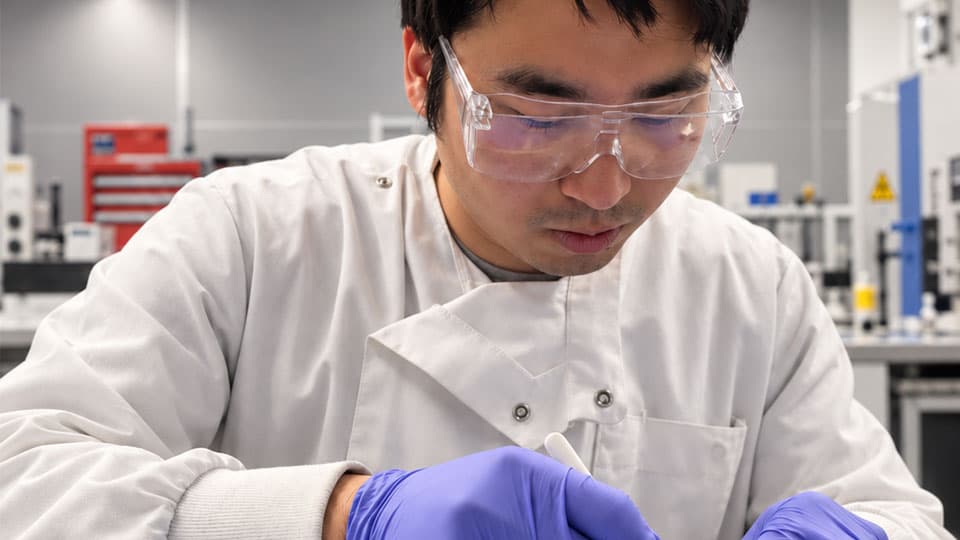
Every battery begins long before it’s assembled into an electric vehicle or a mobile phone – it begins with the manufacturing processes that determine how well it will perform for years to come. Improving those processes is the focus of Dr Pengcheng Zhu‘s research at Loughborough University, where he is developing advanced manufacturing techniques to enable the next generation of batteries to deliver higher performance, greater efficiency and improved sustainability.
Pengcheng’s motivation is both scientific and personal. He said: "After having my daughter, I realised I had to think about what I could leave for the next generation.”
That perspective led him towards battery research, where he now focuses on developing technologies that can contribute to a cleaner, more sustainable energy future.
Finding a path into battery research
Pengcheng completed his PhD at the University of Liverpool in 2019, where he specialised in porous metal manufacturing. Although his doctoral research was not focused on batteries, it provided the manufacturing expertise that would later underpin his career.
As global attention increasingly turned towards electrification and energy storage, he recognised the importance of the field.
He explained: "It made me think this was something we needed for the future; energy is such an important challenge.”
His first job application to join a Faraday Institution project was unsuccessful. Rather than being discouraged, he continued building experience, spending a year at the University of Warwick researching lithium-ion battery recycling before joining the University of Birmingham in 2020. There, he became involved in two Faraday Institution projects: Nextrode, and CATMAT.
Engineering better batteries
Pengcheng secured his position as a lecturer in sustainable energy engineering at Loughborough in November 2025, a milestone he sees as the result of persistence, collaboration and years spent building a distinctive research direction. Now leading his own research group, his research centres on improving battery manufacturing from the ground up.
He added: "The six years between completing my PhD in 2019 and securing my lectureship in 2025 were long and challenging.”
One challenge was moving from a different research background into battery research. Another was navigating a difficult academic job market.
"I kept building my experience, track record and reputation, while staying positive and proactive, which eventually led me to current position.”
His group studies how batteries are made, examines the structure of battery electrodes, explores how those structures affect lithium-ion movement, and tests how these factors influence battery performance.
Continues...
The full interview is available on The Faraday Institution website.