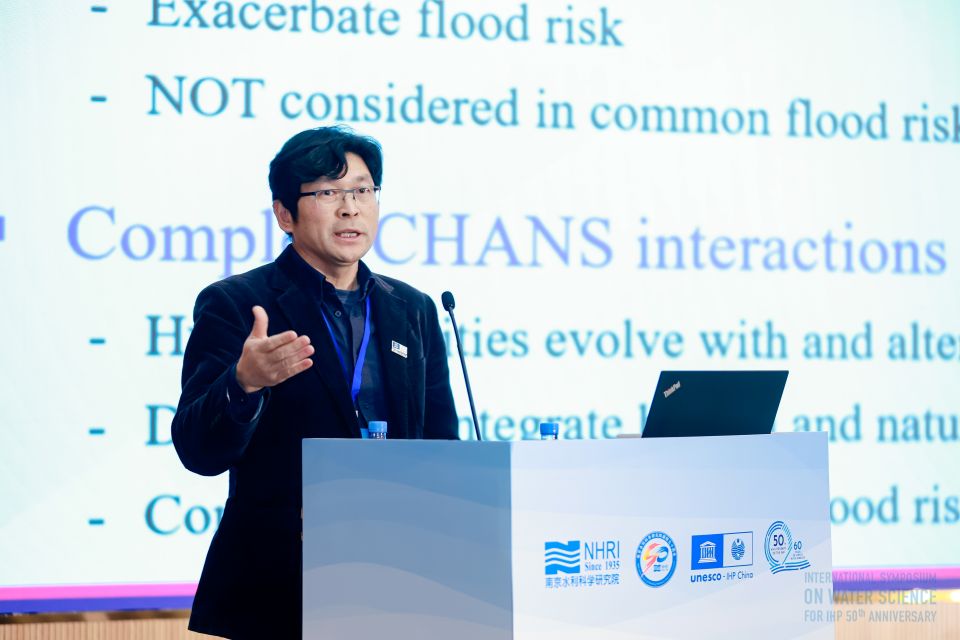
Professor Qiuhua Liang, from Loughborough's School of Architecture, Building and Civil Engineering, is among 20 new Turing AI Fellows announced by UKRI as part of a £39 million investment in strengthening the UK's artificial intelligence capability.
His project, HiPA-Flood: High-Performance Computing and AI for Personalised Flood Forecasting and Resilient Futures, will explore how advanced AI technologies can be combined with high-performance computing to deliver more accurate, localised flood forecasts and help communities better prepare for future flood risks.
The fellowship is part of UKRI's Turing AI Pioneer Interdisciplinary Fellowships programme, which supports researchers using AI to address major societal challenges. The new cohort of fellows will apply artificial intelligence across a range of fields, from personalised medicine and clean energy to environmental sustainability and infrastructure resilience.
Flooding remains one of the UK's most significant climate-related risks, with extreme weather events increasing in frequency and severity. Professor Liang's research aims to develop next-generation forecasting approaches that can provide personalised, real-time flood information tailored to specific locations and circumstances, supporting more effective decision-making by individuals, communities, emergency responders and policymakers.
Professor Liang said: “It is a great privilege and honour to receive a Turing AI Pioneer Interdisciplinary Fellowship. More importantly, the fellowship provides the support needed to focus on a major societal challenge - using the latest advances in high-performance computing and AI to transform surface water flood forecasting and warning.”
The Turing AI Fellowships are delivered by the Engineering and Physical Sciences Research Council (EPSRC) and form part of UKRI's wider investment in artificial intelligence through its AI Priority Programme. The fellowships are designed to give outstanding researchers the freedom and support to advance AI research while accelerating its application across disciplines.
Professor Charlotte Deane, Senior Responsible Owner for the UKRI AI Programme and Executive Chair of EPSRC, said: “AI has enormous potential to transform the way we understand and tackle some of the biggest challenges facing society. These fellowships will give outstanding researchers the freedom and support to push the boundaries of AI itself, while also applying it in new ways across a wide range of disciplines.
“By investing in exceptional people and ideas, UKRI is helping to build the expertise and capability the UK needs to remain at the forefront of AI research and innovation, and to turn advances in AI to advance knowledge, improve lives and drive growth across the UK.”
The fellowship further strengthens Loughborough University's growing reputation for research and innovation in artificial intelligence, environmental resilience and digital technologies, while supporting the development of solutions to some of the most pressing challenges posed by climate change.
The Turing AI Pioneer Interdisciplinary Fellowships began in October 2026 and will run for three years.