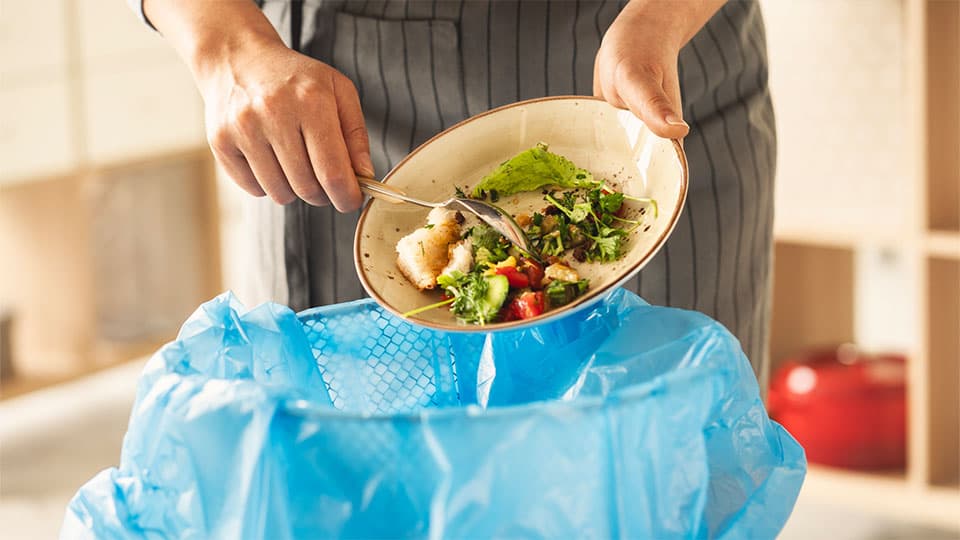
Globally, around one-third of all food produced for human consumption is never eaten. That is roughly 1.3 billion tonnes of food grown or reared that never enters anybody’s mouth. And of course, food is lost or wasted at every stage of the supply chain, from agricultural production and processing through to retail and consumption. However, in all parts of the world, but especially the most advanced economies, by far the largest proportion of food waste is generated from households.
When food is wasted, we are not simply throwing away the final product, we are also wasting all of the resources required to produce it. Every kilogram of food embodies land, water, energy, fertilisers, labour, transport and packaging. By the time food reaches our homes, restaurants or workplaces, significant resources have already been invested in its production and so discarding this food means that the environmental impacts generated at every stage of the supply chain have been incurred in vain. For this reason, food wasted by consumers carries the highest environmental cost across the whole supply chain.
The climate implications are substantial. Food systems account for over a quarter of global greenhouse gas emissions, so when food is wasted, many of those emissions have effectively been generated for no benefit, and the discarded food also represents a waste management challenge, which has further environmental impacts. But unlike many climate challenges, reducing food waste does not require major scientific breakthroughs.
In many cases, the necessary solutions already exist:
- Improved forecasting can help organisations better match supply and demand
- Better inventory management can reduce losses throughout manufacturing and retail operations
- Enhanced supply chain visibility can identify where waste occurs and allow targeted interventions
- Simple consumer actions, such as meal planning, appropriate storage and a better understanding of best before and use-by dates, can also make a significant difference
This is not to suggest that the challenge is easy. Far from it. Food supply chains are characterised by low operating margins and a high proportion of small businesses, both of which can limit the resources available for innovation and continuous improvement. Effective waste reduction often requires investment, data sharing and collaboration across multiple organisations, all of which are difficult to achieve in practice.
These challenges are further compounded by the increasing impacts of climate change on agricultural production and supply chain resilience. And of course, geopolitical tensions add a further layer of disruption to having a stable and efficient food supply system. Consequently, despite the clear environmental and societal benefits, food waste prevention has historically received less strategic attention and investment than its potential significance warrants.
There is also a need to change the way we think about food itself. In many developed economies, food has become so readily available that waste is often accepted as a normal consequence of modern living. Yet food is arguably our most valuable resource.
We can generate renewable energy, manufacture new products and develop new technologies, but none of these can replace the fundamental human necessity of food. Reducing food waste therefore requires not only better systems and technologies, but also a renewed appreciation of the resources embedded within the food we consume.
As COP31 continues, food waste deserves greater recognition as a climate action priority. It offers a rare opportunity to deliver environmental, economic and social benefits simultaneously. And food waste represents one of the few opportunities where meaningful reductions can be achieved relatively quickly using existing knowledge and technologies.
We already understand the problem, and many of the solutions are readily available. The challenge now is implementation. If we are serious about reducing emissions and using resources more sustainably, tackling food waste must become a central part of the conversation.
In a world facing growing environmental pressures and increasing demand for food, preventing waste is not simply good practice; it is one of our most promising opportunities.
Keep up-to-date with all of our COP31 activity at our dedicated hub.
