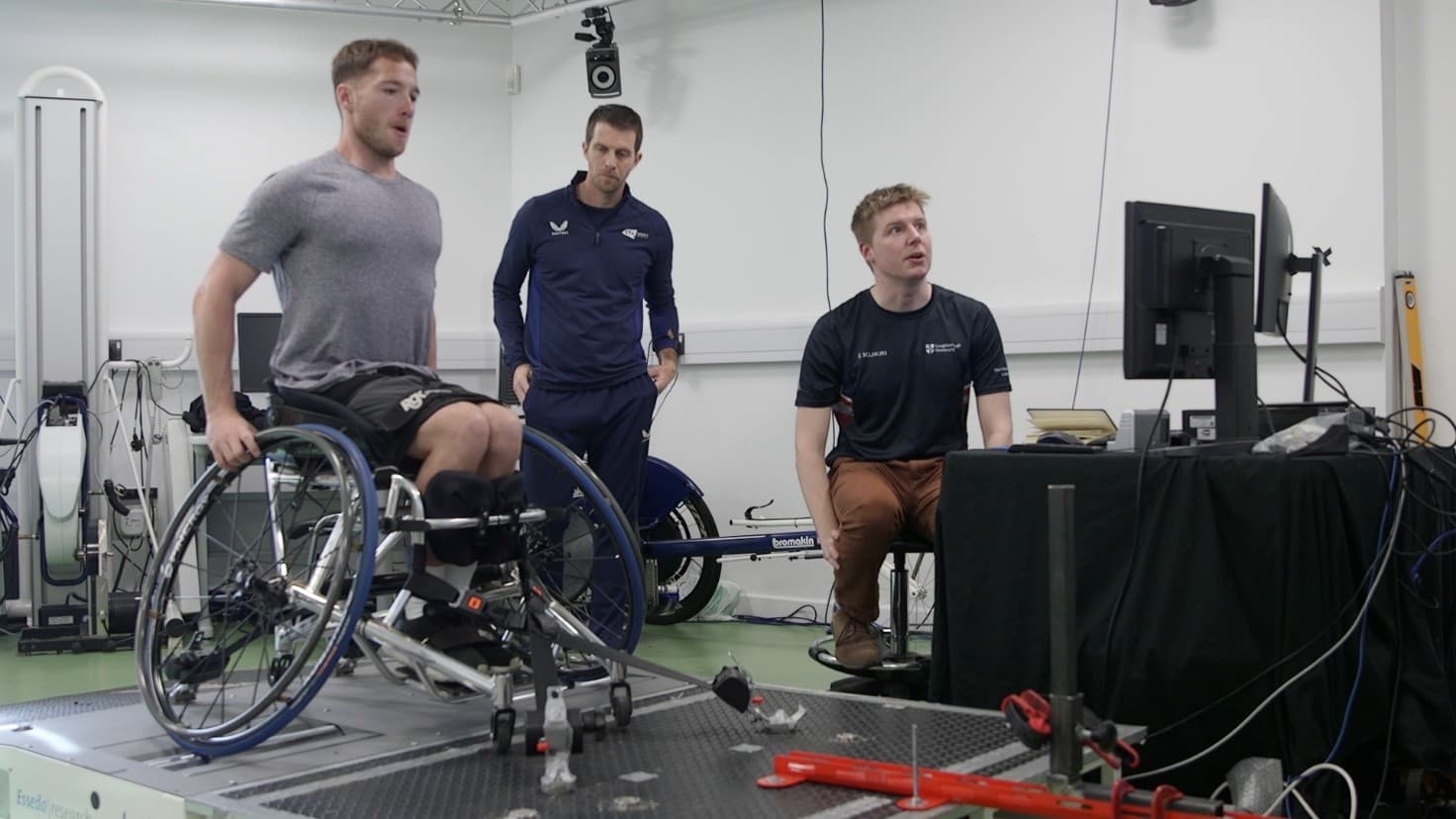
The Centre for Para and Disability Sport Innovation has developed a strong research partnership with the LTA and GB wheelchair tennis players, alongside collaborators including the All England Lawn Tennis Club, RGK Wheelchairs, Sheen Parasport and the UK Sports Institute. Together, they are tackling key questions around how athletes move, compete and optimise their equipment across different court surfaces, with grass presenting some of the sport’s most distinctive challenges.
This work is part of the wider body of para and disability sport research that contributed to Loughborough University being awarded the 2025 Queen Elizabeth Prize for Higher and Further Education, recognising its pioneering contribution to performance, wellbeing and inclusion in para and disability sport.
Understanding how wheelchair tennis can be played safely and effectively on grass courts has been a major focus for the Centre. Having investigated player perceptions, physical demands and wheelchair configurations, Loughborough researchers found that grass is often experienced as the most physically demanding surface due to increased rolling resistance, movement difficulty and fatigue. Their work has also highlighted the importance of optimising chair set-up, including tyres and castors, to support performance while helping to protect the court surface.
The Centre’s work in wheelchair tennis also extends beyond equipment. A recently completed doctoral project explored perceptual-cognitive expertise in returning serve, showing that expert wheelchair tennis players are highly skilled at reading early cues from an opponent’s service action. This led to the development of a prototype perceptual-training tool to support younger and developing players. Building on this foundation, a new PhD project is now tracking elite wheelchair tennis players over two years to compare the movement and tactical demands of hard, clay and grass courts. The project aims to address gaps in evidence relating to female and junior athletes, support surface-specific preparation and establish benchmarks for future Paralympic cycles.
Loughborough has also worked with the LTA, UK Sports Institute, Sheen Parasport and RGK Wheelchairs on wheelchair optimisation for Alfie Hewett, with research into biomechanical optimisation in the development of a new chair for his 2026 season.
Many athletes involved in Loughborough’s research are headed to the Lexus British Open Roehampton this week with hopes of qualifying for the Wimbledon Championships.
Paralympic gold medallists, former world No.1s and Men’s Wheelchair Doubles teammates Alfie Hewitt OBE and Gordon Reid OBE will play in the Men’s Wheelchair Singles, alongside Andrew Penney who will be making his Wimbledon debut.
In the Women’s Wheelchair Singles, Lucy Shuker, Paralympic silver medallist, and Cornelia Oosthuizen, European Para Championships silver medallist, were the recipients of wildcards.
Andy Lapthorne, winner of 18 Grand Slam titles, will play in the Quad Wheelchair Singles, as well as Paralympic silver medallist Greg Slade.
Professor Vicky Tolfrey said: “Wimbledon provides a powerful platform to show how research can make wheelchair tennis more inclusive, more evidence-led and more performance-focused. Some of our work will be showcased in the Wimbledon Museum this year, marking the 50th anniversary of wheelchair tennis.”
Together, these projects demonstrate how Loughborough’s athlete-centred research is helping to shape the future of wheelchair tennis, from Wimbledon grass courts to future Paralympic cycles.
View the associated research article