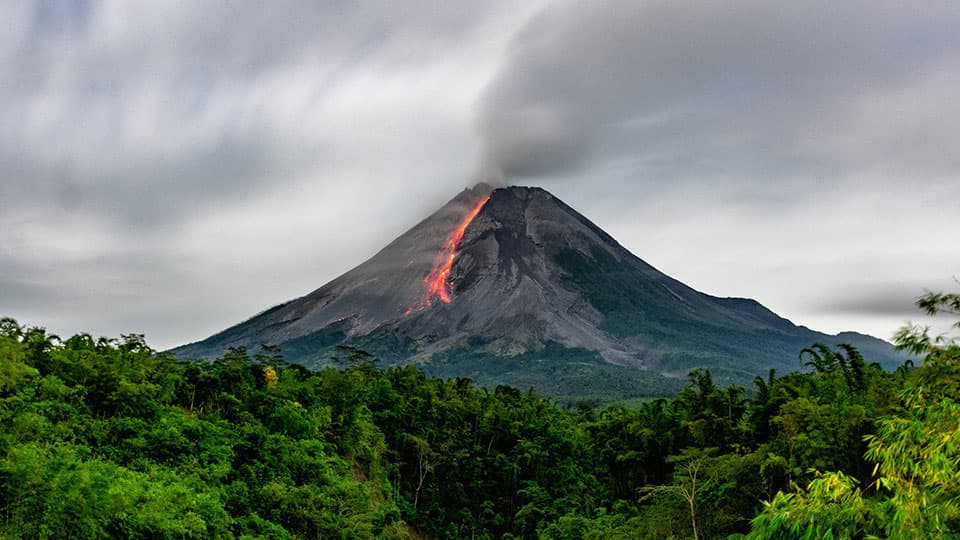
The newly published paper groups these misconceptions into six themes: seismology, volcanoes and climate, volcanic systems and structures, volcanic hazards, timescales, and photographs and footage.
Commonly misunderstood subjects include attention-grabbing terms such as “Pacific Ring of Fire”, “supervolcanoes”, and “mega-tsunamis”, high-profile science topics such as climate or human health, aspirational science goals such as eruption forecasts, and basic terminology, including the difference between volcanic ash and smoke, or the concept of magma “chambers”.
Over the course of a typical year, 70 to 80 different volcanoes erupt across 25 to 30 countries. This is a small subset of the ~1,260 volcanoes thought to have been active in the past roughly 12,000 years.
An estimated 8% of the world’s population lives within areas that could be impacted by volcanic hazards; in 2015, more than one billion people lived within 100 km of an active volcano, and 59 million lived within 10 km.
The authors of this review, including Loughborough University’s Professor Rebecca Williams, bring decades of experience from national agencies, volcano observatories and universities, having worked during and between volcanic crises around the world, including in Indonesia, the Philippines, New Zealand, Australia, Chile, the United States, and Europe. Throughout that time, they have often been at the forefront of the media response, seeing first-hand where misinformation emerged and how to get the story straight.
The authors developed this resource to help volcanologists, journalists, decision-makers, and the public to get the story straight when the next volcano erupts, or doesn’t.
The paper pairs each misconception with key takeaway points and summaries of recent research, giving readers the information they need to explain these topics accurately.
It also presents seven case studies showing how incorrect information was widely shared and counteracted at well-known volcanoes and recent eruptions at Mount Agung (Bali, Indonesia), Mount Etna (Sicily, Italy), Kīlauea (Hawaii, U.S.A.), Tajogaite (La Palma, Spain), La Soufrière (St. Vincent), Taal Volcano (Philippines), and Yellowstone caldera (U.S.A.).
One example detailed by the review is the concept of the ‘Pacific Ring of Fire’, with common misconceptions stating that the majority of volcanic eruptions occur at this location and their volcanoes are linked in one system, and can thus trigger simultaneous eruptions.
However, the paper explains that whilst it might be a popular and evocative description for the events that occur in this area, the number of volcanoes in this area is not notably greater than in other parts of the world. However, they do account for more of the overall confirmed eruptions since both 1800 (59%) and 1960 (69%).
Professor Rebecca Williams, Professor of Volcanology at Loughborough University’s School of Architecture, Building and Civil Engineering, said of the publication: “This work drew on decades of experience as science communicators, as well as analysis of hundreds of media articles . The misconceptions we reveal and discuss in the paper is not just a matter of semantics. Misconceptions can lead to public anxiety and either an overestimation or underestimation of the danger at hand, making crisis management challenging. We hope that by setting the story straight, we can help journalists and the pubic recognise misinformation and assess the evidence behind the claims, leading ultimately to better decision making.”
Volcanoes and their eruptions fascinate people because of the natural spectacle they often provide. They are a symbol of how dynamic the Earth we live on is. But they can also pose a formidable risk to infrastructure, air traffic, and the people living around them.
Providing science-based, accurate information during a volcanic crisis can be a literal matter of life or death. The ability to rapidly disseminate scientific knowledge across the world has never been greater, but rumors often spread faster. Popular misconceptions can take root and, without correction, lead to risky situations.