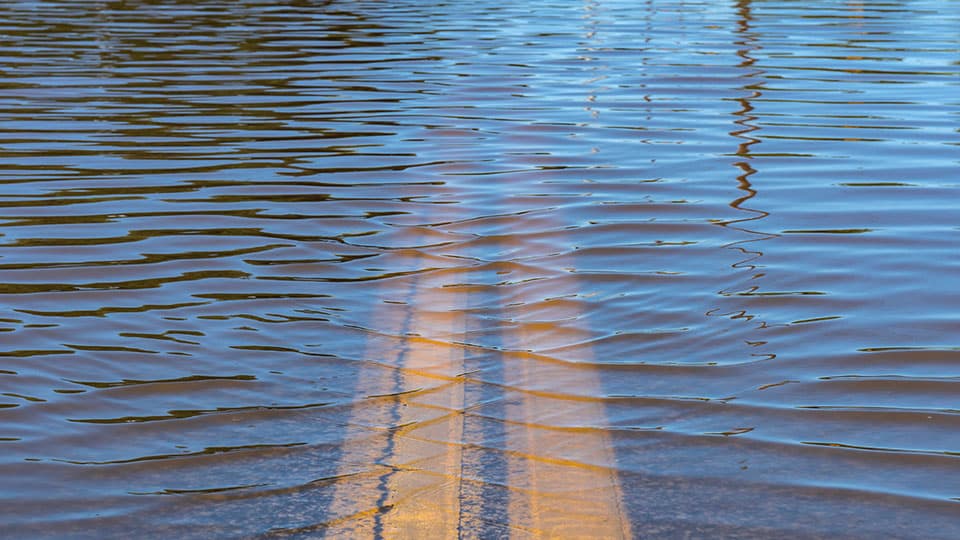
With rescue operations currently underway, experts from Loughborough University have commented on the events.
Professor Dan Parsons, Professor in Geosciences at Loughborough University's School of Geography and Environment, said:
"The floods that hit Nepal and the Tibetan border region are, above all, a human tragedy. Scores of people are confirmed dead, hundreds are still unaccounted for, and homes, roads, bridges and hydropower infrastructure have been swept away. Rescue operations are ongoing and it will be some time before the full scale of the disaster is known.
"But the event is also a reminder of something that those of us working on Himalayan hazards keep coming back to: these things rarely happen in isolation.
"Early satellite imagery suggests part of a steep glacier close to the Nepal–Tibet border collapsed, sending a large mass of ice and rock more than a kilometre down into the valley below. That appears to have generated, or fed into, a huge surge of water, sediment and boulders moving through the river system. Quite how that sequence unfolded and where the sheer volume of water came from, whether a temporary blockage formed and then failed will take weeks if not months to pin down properly.
"But it's already fairly clear that calling this a "flood" undersells what actually happened. What we seem to be looking at is a disaster that started high in the cryosphere, moved through a major slope failure, interacted with the river network, mobilised huge amounts of sediment, and only then arrived downstream as something that looked, by the time it reached people and infrastructure, like a flood. Ice failure, rockfall, sediment, river, flood, damage. In effect it is a chain, not a single event, and treating it as one thing hides most of the interesting and useful science."
"On a NERC-funded project I'm involved in, Dynamic Risks for Cascading Himalayan Hazards, we started from a fairly simple frustration: hazard assessment tends to treat earthquakes, landslides and floods as separate problems.
"You map where landslides are likely, you identify flood-prone areas, you keep an eye on locations already known to be risky. Mountains, unfortunately, don't respect those categories. One event changes the conditions for the next. A landslide blocks a river; the lake behind it eventually breaches and produces a flood; that flood carries a huge sediment load downstream; the sediment raises riverbeds or chokes channels further down the valley, which changes where and how badly the next monsoon floods.
"Glaciers retreating out of a valley leave something similar behind — large volumes of loose, unstable material that our project has taken to calling "sediment bombs," stored up in steep catchments until something else comes along to mobilise them.
"The point is that risk isn't fixed. What happens today can reshape the landscape in ways that change what a community is exposed to tomorrow. That's really what we mean when we talk about dynamic risk in this context.
"Our fieldwork is centred on the Garhwal Himalaya in Uttarakhand, which has already seen this kind of cascading disaster play out — Kedarnath in 2013, Chamoli in 2021 — but the underlying problem isn't specific to that one valley. Across the Himalayan arc, glaciers, hillslopes and rivers sit close together on very steep terrain, so a change high up in a catchment can have consequences tens or hundreds of kilometres downstream. It's happening elsewhere too: from the Andes to the Alps."