In pictures: Making a four-metre-tall bronze sculpture that fuses British innovation and Chinese tradition

DesignWorld
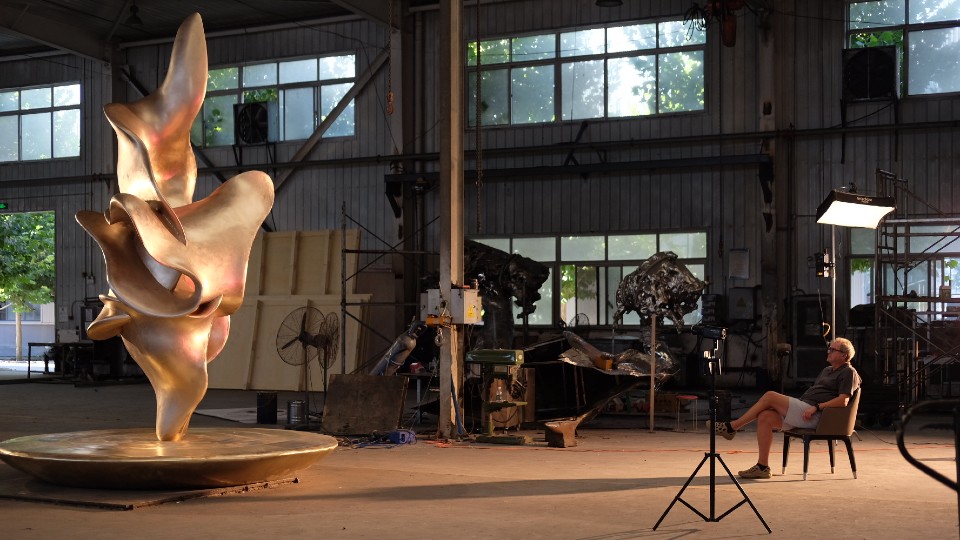
A large abstract metallic sculpture stands on a circular base inside an industrial workshop, lit by warm studio lights, while artist John Atkin sits on a chair to the right facing it, with photography equipment, windows, and workshop tools visible in the background.

British sculptor and Loughborough University Reader in Fine Art, John Atkin, pictured with his latest work 'Heirloom' ahead of its shipment to its final destination in Guangzhou. Image courtesy of AaRT.

British sculptor John Atkin has unveiled his latest creation, Heirloom (The Water Sleeve Dancer) – a four-metre-tall bronze sculpture weighing more than two tonnes – alongside a series of behind-the-scenes images that reveal how the monumental work was brought to life.

Atkin, a Reader in Fine Art at Loughborough University, was commissioned to create a sculpture that captures the creative spirit of Guangzhou, for installation at a landmark site beside the Pearl River.

The work draws inspiration from the flowing movements of Cantonese Opera’s water sleeve dancers, whose long, billowing sleeves are used to express emotion.

“Working through a combination of digital and traditional sculptural methods, I began to explore geometric forms that could be stretched, folded, and intertwined to evoke the flow of draped fabric and the rhythm of a moving body”, said Atkin, a former student of the Royal College of Art, who was personally funded during his MA by Henry Moore OM CH.

Heirloom stands as both a gesture of cultural exchange and a testament to historic craftsmanship, merging digital precision with the enduring resonance of bronze.”

How it was made

Working with skilled craftspeople, Atkin developed a series of digital models and animations to test the sculpture's scale, placement, and materials. He selected bronze for “its sense of permanence and heritage, and for its resonance with the nearby Pearl River as a symbol of continuity and renewal”.
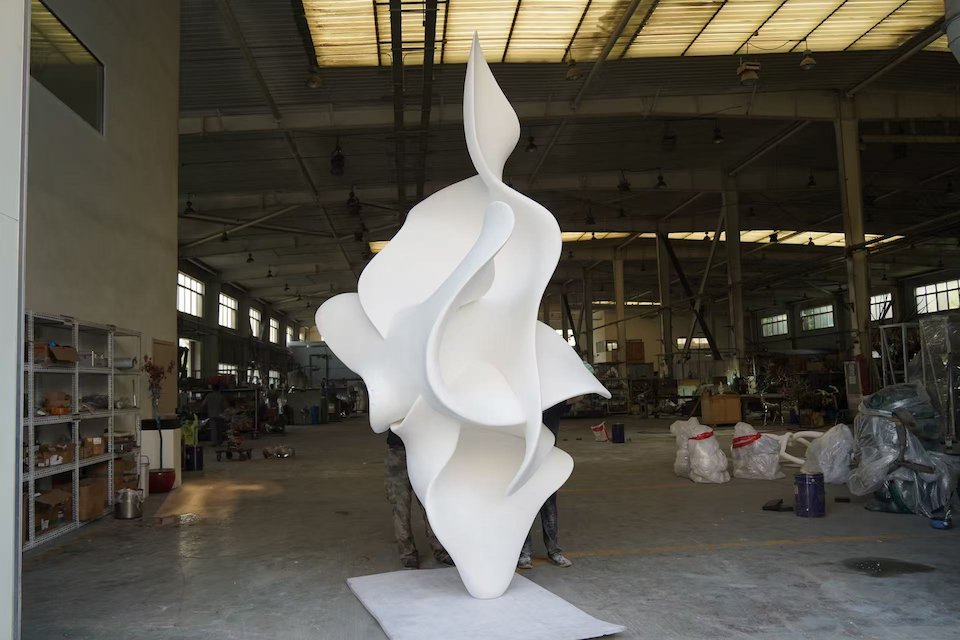
A full-scale plastic prototype was 3D-printed at a foundry in Tianjin, where Atkin refined the surface contours and detailing. From this, a multi-part mould was created, allowing a wax pattern to be produced in preparation for bronze casting.

The full-scale polystyrene prototype of ‘Heirloom’. Image courtesy of AART.

The full-scale prototype of Heirloom. Image courtesy of AaRT.

Molten bronze was poured into the moulds to create a series of sections, which were later welded together around a concealed steel framework for strength and stability. Each join was carefully ground and polished until the surface appeared seamless, with the final stage of polishing completed by hand.
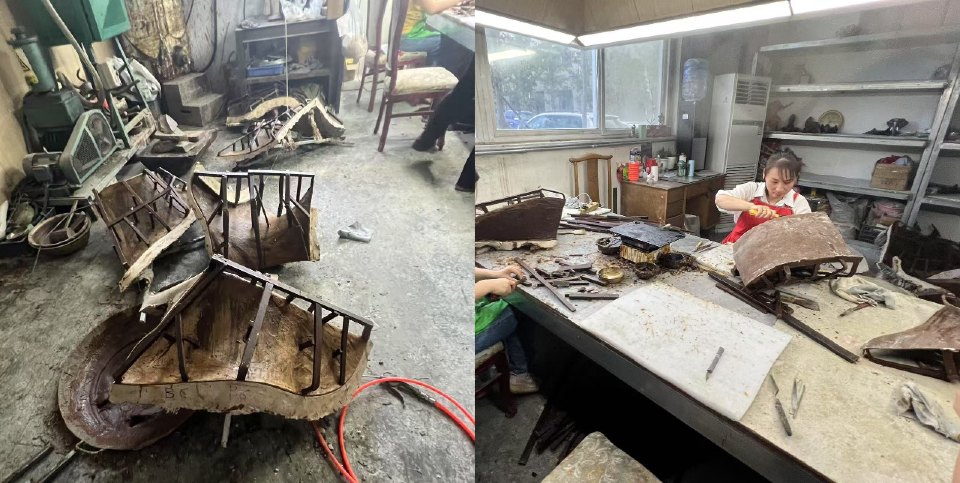
Split image of a workshop in two stages: on the left, several curved metal moulds and frames are laid out on a dusty factory floor; on the right, a craftsperson sits at a workbench carefully shaping and assembling metal pieces, with tools, materials, and shelving visible around them.

Left: The bronze segments of Heirloom are built around concealed steel frames. Right: An artisan working on a segment. Image courtesy of AaRT.

Up to six artisans worked simultaneously to achieve the sculpture’s flowing form, sanding and buffing the metal until the bronze reflected light like draped fabric.

The final stage was ‘patination’ – heating the bronze and brushing on chemical solutions to create its warm tone. The colour was sealed with wax and hand-polished to a soft sheen that shifts subtly with changing light.
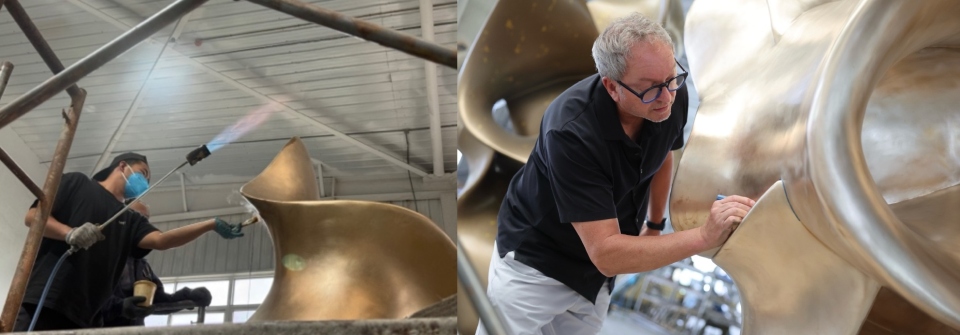
Split image showing two stages of work on a large metallic sculpture: on the left, a person wearing a mask uses a blowtorch to heat and patinate the surface; on the right, John Atkin carefully brushes and refines the gold-toned metal by hand, highlighting the detailed finishing process.

Left: An artisan patinates a segment of Heirloom. Right: Artist John Atkin applies the finishing touches to a section of his sculpture. Image courtesy of AaRT.

Where to see it

Heirloom has been installed at the entrance of the Poly Guangzhou Tianhe District development on Linjiang Avenue – a new mixed-use complex overlooking the Pearl River.
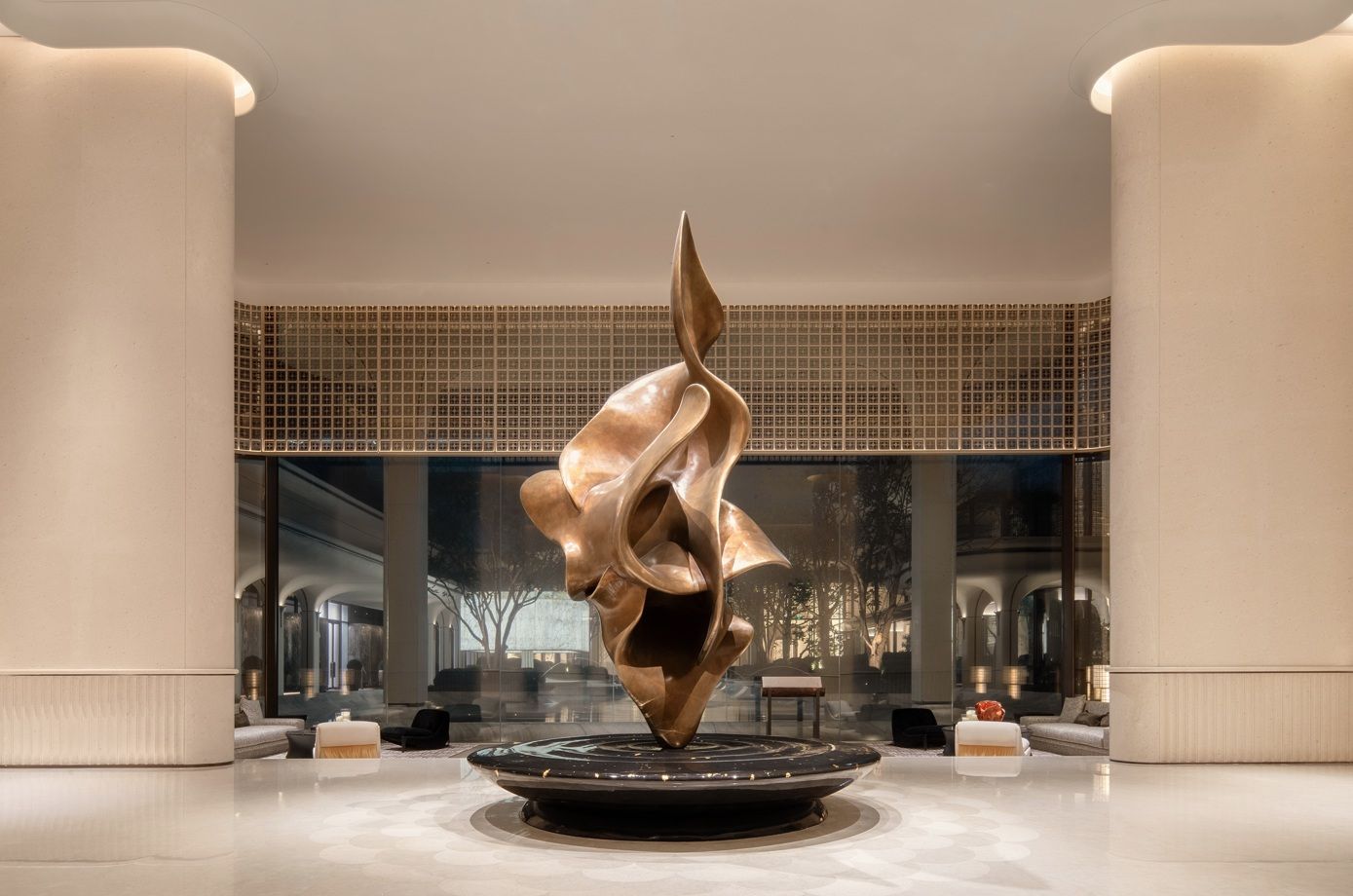
A large abstract metallic sculpture stands on a circular base inside a grand building with cream walls, and a marble floor.

Heirloom stands proudly in the entrance of the Poly Guangzhou Tianhe District development on Linjiang Avenue. Image courtesy of AaRT.

A spokesperson from AaRT Public Art Organisation, which commissioned the sculpture, said: “We deeply admire John Atkin's unwavering pursuit of artistic excellence, and his work has been a great source of inspiration for us.”

Notes for editors

Press release reference number: 26/16

Loughborough is one of the country’s leading universities, with an international reputation for research that matters, excellence in teaching, strong links with industry, and unrivalled achievement in sport and its underpinning academic disciplines.

It has been awarded five stars in the independent QS Stars university rating scheme and named the best university in the world for sports-related subjects in the 2025 QS World University Rankings – the ninth year running.

Loughborough has been ranked seventh in the Complete University Guide 2026 – out of 130 institutions.

This milestone marks a decade in the top ten for Loughborough – a feat shared only by the universities of Oxford, Cambridge, LSE, St Andrews, Durham and Imperial.

Loughborough was also named University of the Year for Sport in the Times and Sunday Times Good University Guide 2025 - the fourth time it has been awarded the prestigious title.

In the Research Excellence Framework (REF) 2021 over 90% of its research was rated as ‘world-leading’ or ‘internationally-excellent’. In recognition of its contribution to the sector, Loughborough has been awarded eight Queen Elizabeth Prizes for Higher and Further Education.

The Loughborough University London campus is based on the Queen Elizabeth Olympic Park and offers postgraduate and executive-level education, as well as research and enterprise opportunities. It is home to influential thought leaders, pioneering researchers and creative innovators who provide students with the highest quality of teaching and the very latest in modern thinking.