Scope and Boundaries
All substantial activities undertaken by the University should be considered in relation to their potential impact on equality, diversity and inclusion. This includes, but is not limited to, new or revised policies, major procedures, strategies, services, projects and programmes, including changes to or removal of existing services.
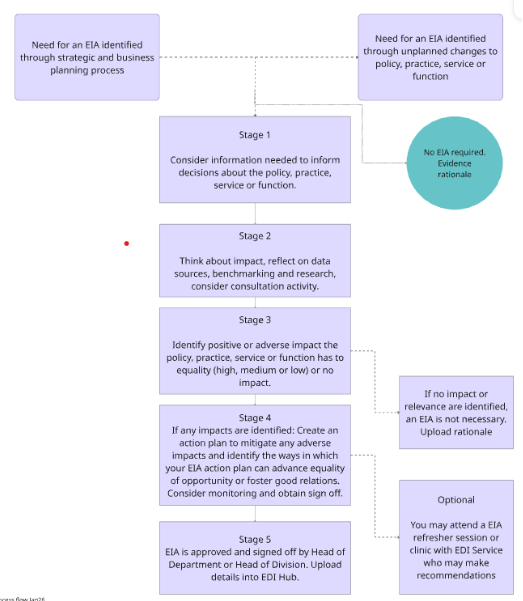
Not all activities will require the same level of assessment. Equality Impact Assessments should be applied in a proportionate and risk-based way, recognising that some activities will have a greater potential impact on staff, students or other stakeholders, or present a higher risk of unintended or adverse effects on particular groups.
When deciding whether an EIA is required, and the appropriate level of assessment, consideration should be given to:
- the nature and purpose of the activity;
- the scale and significance of the proposed change;
- the number and characteristics of people likely to be affected;
- whether protected characteristics or agreed marginalised groups may be disproportionately impacted; and
- the extent to which any potential impacts can be mitigated or enhanced through reasonable adjustments or alternative approaches.
In some cases, it may not be necessary to conduct a separate EIA for individual components of a policy, project or activity where an Equality Impact Assessment has already been undertaken at an overarching level. However, this should be judged carefully, and teams should be satisfied that the existing assessment adequately covers the specific elements being delivered.
The greater the potential for adverse or differential impact on people who share a protected characteristic, or on marginalised or vulnerable groups within the context being considered, the more detailed and robust the Equality Impact Assessment will need to be. This ensures that the University meets its duties under the Equality Act 2010 and supports fair, inclusive and evidence-based decision-making.
Equality Impact Assessment is an ongoing process. Even where a decision is taken that a full EIA is not required, the rationale should be recorded and the activity should continue to be monitored and reviewed as it is implemented or as circumstances change.