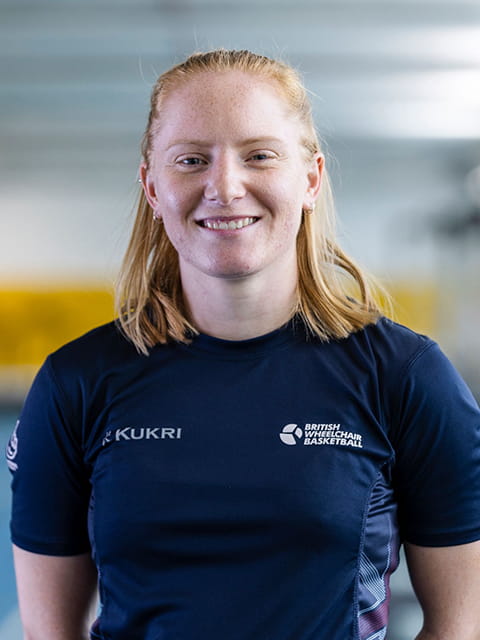
Pippa completed her BSc in Sport and Exercise Science in 2019 at Loughborough University, during which she undertook a sandwich year as a Sport Science Intern at the University of Bath. She then stayed in Loughborough to complete an MSc in Exercise Physiology, where she began a 2-year placement with Loughborough Sport Triathlon Centre as a physiologist, conducting laboratory and field testing across swim, run and bike disciplines.
Her interest in academia and applied physiology support led her to pursue an applied PhD joint funded by the Peter Harrison Centre for Disability Sport (PHC) and British Wheelchair Basketball (BWB) in 2021. Her applied research focused on understanding the physiological and movement demands of female wheelchair basketball competition and training at a variety of competition levels, to aid in the design of training programmes for athletes to compete at the highest level.
During her doctoral research, Pippa provided physiological support for BWB, leading in-session load monitoring using IMU technology and heart rate measurements to provide feedback on the intensity of training design. She also developed and led the daily wellness monitoring system and contributed to the periodisation of camp planning and individual training plans. Pippa led on the education and delivery of individualised recovery, travel, jetlag, and heat acclimation strategies and was the Team Manager for the women’s squad at the 2023 and 2025 European Championships where they won silver medals.
Pippa is a Research Associate/Performance Scientist at the Peter Harrison Centre for Disability Sport, working with Professor Vicky Tolfrey.
Pippa’s doctoral research investigated the application of individualised speed zones in wheelchair basketball, to account for the variation in speed profiles across classification and impairment types in the sport. She also examined the physiological and movement demands of domestic and international level competition and training sessions, to aid the interdisciplinary staff and coaching team to design training sessions that better meet the demands of competition. Her research highlighted the drop off in intensity load metrics across playing quarters and tournament games, and examined longitudinal training load, wellbeing and menstrual cycle data across a winter training cycle to evaluate the balance between adaptation to training and wellbeing responses.