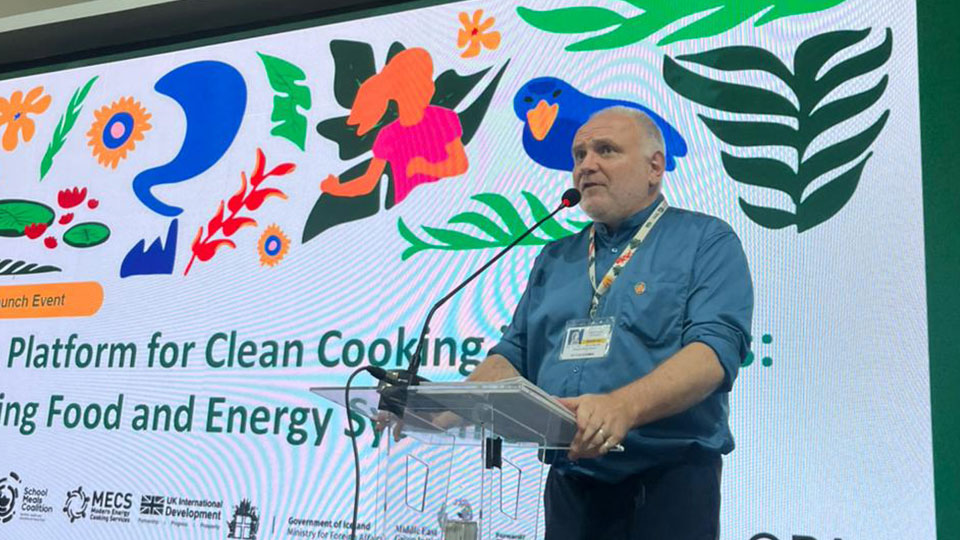
In the climate-critical Amazon rainforest, Loughborough researchers spearheaded initiatives that are turning climate commitments into measurable, real-world action.
The university’s delegation, led by Professors Mark Howells and Ed Brown from the university’s Geography and Environment department, played a pivotal role in shaping the COP30 Action Agenda—the pillar of the convention designed to mobilize civil society, businesses, and countries to accelerate the transition to a sustainable future.
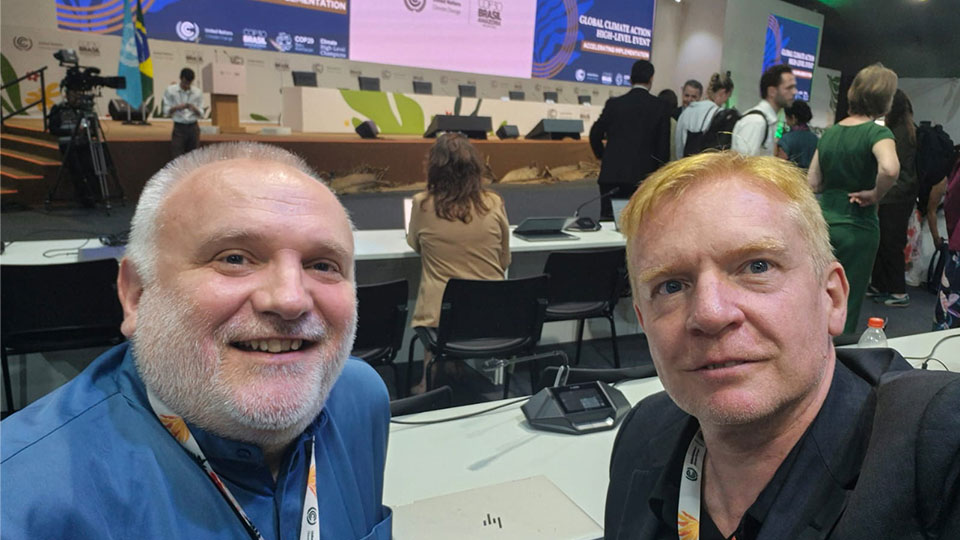
Photo credit: Professor Mark Howells
CCG: Scaling Data-Driven Finance and Global Capacity
The CCG programme was one of the projects that achieved political recognition at COP30. Its work with the Green Grids Initiative (GGI) received official endorsement from the COP30 President and was spotlighted by the UK’s Secretary of State for Energy Security and Net Zero, Ed Miliband. This high-level support underpinned an increase in global grids and storage pledges totalling hundreds of billions of dollars.
A landmark achievement was the formal launch of "Data-to-Deal (D2D): A Guide for Practitioners," a framework co-developed with 30 organisations to bridge the gap between energy modelling and climate finance.
The D2D approach has already successfully enabled three small countries to attract over USD 11 billion in climate finance, with successful implementations in Latin America and growing impact across Africa and Asia.
Notably, Türkiye’s new national Greenhouse Gas (GHG) modelling framework—the world’s first government-run system built on CCG’s open-source tools—was showcased as the technical backbone of their 2053 net-zero target.
In 2026, CCG will work directly with the COP31 Presidency to update their GHG mitigation analysis and establish a global capacity-building effort to help other nations replicate this success.
MECS: Redefining Clean Cooking within the COP Action Agenda
Parallel to these efforts, the MECS programme solidified its influence within the COP Action Zone, led by the launch of the Platform for Clean Cooking in Schools on 18 November. This major collaboration between MECS, SEforALL, SNV, the World Food Programme, and several governments aims to accelerate the transition to clean cooking in educational institutions globally.
The momentum for the expansion of electric cooking (eCooking) was palpable, explained Ed, as MECS led high-level discussions with the COP Presidency and UN Climate Champions to ensure clean cooking is embedded in the Global Mutirão (collective effort), the Presidency’s voluntary action agenda for 2026–2030.
Working with partners like the World Bank and Sustainable Energy for All (SEforALL), MECS has helped develop "Plans to Accelerate Solutions" (PAS)—roadmaps designed to help countries implement the finance commitments necessary for universal clean energy access and will work closely with partners to ensure their delivery.
On 13 November, MECS also contributed a keynote to a joint session with the Brazilian government and the World Bank, while also chairing a review of the Global Electric Cooking Coalition (GeCCo), which has seen remarkable progress since its COP28 launch.
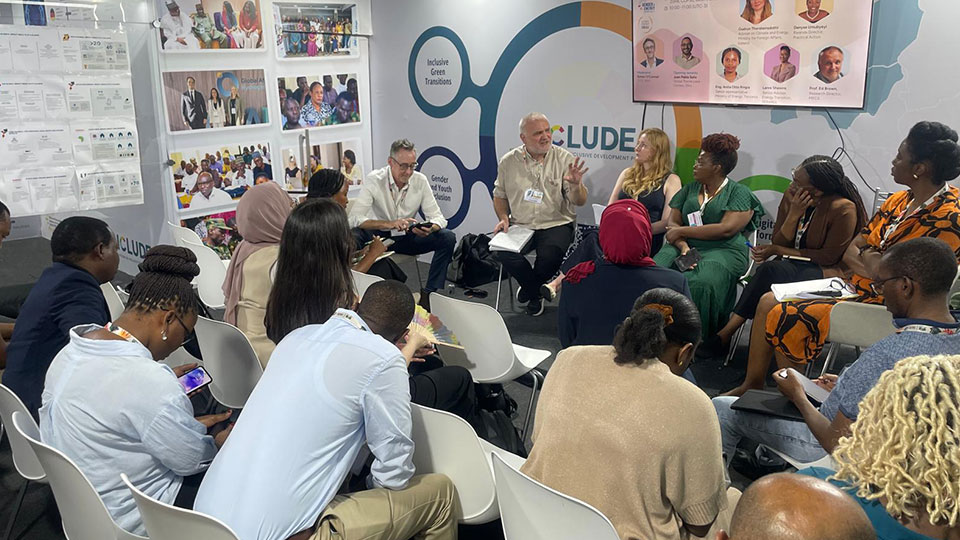
Photo credit: Juan Pablo Solis
A Unified Vision for Global Impact
The presence of both CCG and MECS at COP30 underscores Loughborough University’s unique position at the intersection of research, policy, and implementation. By integrating macroeconomic planning with localized energy solutions, the STEER centre is providing the tools—from D2D modelling to eCooking roadmaps—that allow countries to lead their own transitions.
As COP30 concludes, the impact of these projects is clear: they are not just providing evidence but are building the global capacity and financial pipelines required for a just and equitable climate future.
Find out more and engage with our research here.