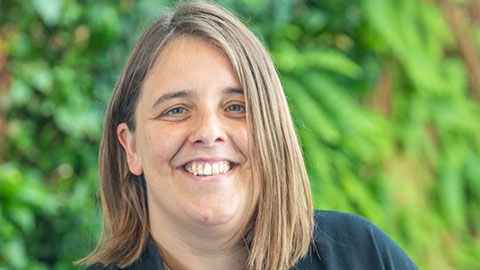
Helen Turner on driving collaboration and talent across the Midlands

Helen Turner shares insights on building one of the UK’s largest university collaborations to strengthen innovation, attract commercial expertise, and accelerate spinout success.

Helen Turner

We’re delighted to welcome Helen Turner, Director of our partner organisation Midlands Innovation, for our first interview feature. Helen - alongside partner universities - initiated, designed, and created the Forging Ahead project. Firstly, Happy new year of course!

Thank you and thank you for having me!

Forging Ahead (FA) has the pleasure of meeting and working with founders and commercialisation teams from across the Midlands. Can you give us a bit of insight into how Forging Ahead came into being?

When the Connected Capabilities Fund-Research England call came out over a year ago, I saw this as a major opportunity. This was a chance to build a programme that would sit alongside Midlands Mindforge and work collaboratively to strengthen the commercialisation ecosystem in the region. I wrote the proposal, working closely with colleagues including Dan Parsons Luke Southan and William Wells in particular. Now I see myself as a core part of the Forging Ahead team, I am really excited to see those early ideas develop into delivery.
I have worked with the eight technology transfer offices in Midlands Innovation for 10 years and in our conversations, we agreed that our response should involve all the Midlands universities in our ecosystem. That was how the concept came about.

Why was it felt that something on this scale - one of the UK's largest university collaborations involving over 15 institutions - was needed?

For this call, which was focused on the commercialisation ecosystem, we knew straight away we had to involve as many of the region’s universities as possible to maximise the benefit. We all, ultimately, operate in the same ecosystem. This broad set-up will provide lots of opportunity to connect technology transfer capability between the region's universities, encouraging greater knowledge exchange.
When we were shaping the programme we took an overview of the strengths and weaknesses of the Midlands' commercialisation ecosystem. The components of a successful ecosystem are sometimes listed as: access to capital, available talent, presence of founders, presence of anchor institutions, presence of major corporates, knowledge base and infrastructure.
The weaknesses in our ecosystem stood out as access to capital and challenges our university commercial teams and spinouts face in attracting the right leadership talent. We were already working to address the availability of capital through Midlands Mindforge so we decided to make access to talent the major focus for Forging Ahead, alongside sharing capability and boosting the pipeline of spinouts.
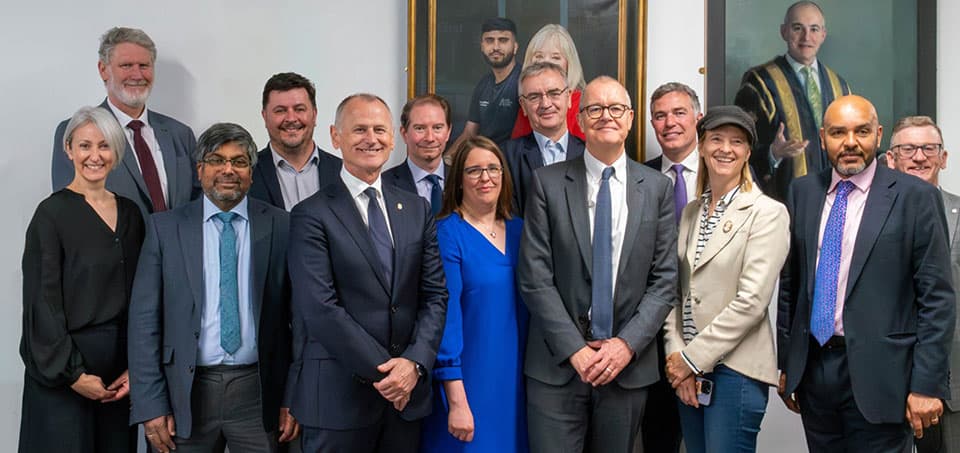
Forging Ahead - group photograph
Senior leaders from Midlands universities gathered for the founding of Forging Ahead, May 2025.

As you say, a significant part of Forging Ahead's work - alongside CRSI - is to attract top commercial talent into the region’s spinouts. Why is bringing in commercial expertise so critical?

When an investor is looking at whether to invest in a spinout the quality of the team is as important as the IP. In the Midlands we sometimes find it challenging to attract top commercial talent into our spinouts whether that is to take up roles on Boards or as CEO.
So the work Gordon Bateman Ian Ashforth and the CRSI team will be doing with the partner universities to bring in that expertise will be instrumental.

The team are now in place with a number of exciting programmes to deliver in 2026 and beyond. What excites you most about the Forging Ahead project?

I think for me it is really seeing how we can build resilient and productive relationships across the technology transfer professionals working in the Midlands at all levels. We did something similar with our Research England-funded TALENT project which has built resilient relationships between our technical professionals and that has generated so many benefits. I'm excited to see the same transformation across the region through Forging Ahead.

Speaking of exciting things, can you give us a few examples of spinout businesses you’re excited to see growing here in the Midlands? 

Well that is a tough question to answer. I don’t really tend to pick favourites. However, quantum technology is a critical technology the government is prioritising. The Midlands is strong in quantum sensing with the University of Birmingham leading the UK Centre for Quantum Sensing, Imaging and Timing. This centre has University of Nottingham and the British Geological Survey as partners. Quantum research has led to the creation of two exciting spinouts in the Midlands:
DeltaG span out of the University of Birmingham and develops quantum sensors that leverage the force of gravity to unlock fast and reliable spatial intelligence for mapping, navigation, and subsurface discovery.
Cerca Magnetics is a University of Nottingham spinout that has developed a wearable brain imaging research system to revolutionise neuroimaging
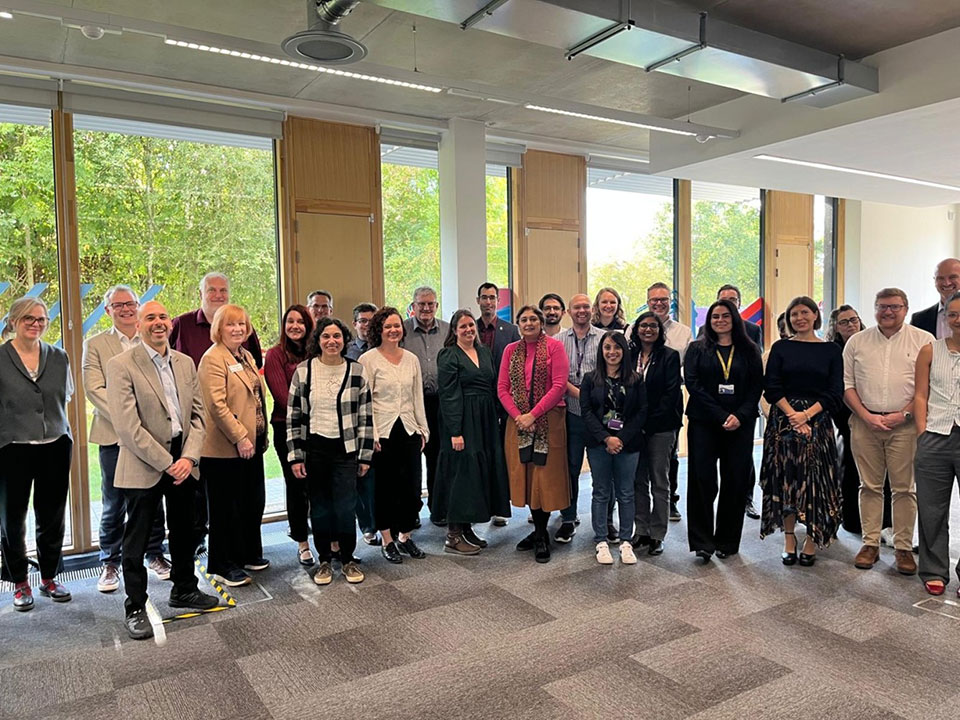
Tech transfer and professional teams group
Tech transfer professionals and commercial teams from each university are closely involved in the project.

Forging Ahead is also expanding a number of initiatives and entrepreneurial training programmes that we know are delivering success, developed by different universities. As someone who worked together with partners to write the Forging Ahead bid submission, it must fill you with pride to see more researchers benefitting from these opportunities?

It is exciting to see these initiatives scaling and as well as more staff benefitting. I am also looking forward to seeing the added benefits that will come from the new connections between universities that we are building.

Forging Ahead is of course creating new pathways for commercialisation too – namely, the pilot IP 2 SME programme developed by University of Warwick. What excites you about this?

There is a lot of emphasis on spinouts at the moment but spinning out a new company isn’t always the right route. IP 2 SME is piloting a new way to stimulate licensing of IP from our universities into local SMEs, trying a different way to ensure that exciting IP is developed in the Midlands region, ensuring we keep that economic benefit local.

If I’m an investor from London or overseas, why should I look to the Midlands now?

There is a wealth of untapped potential in the Midlands. We have fantastic universities producing some fantastic spinouts. Our new Dealroom platform which we launched in October last year gives investors and partners from across the ecosystem a sense of just how much the region has to offer. But there is so much more - we have excellent science parks and locations for innovative businesses, working collaboratively across institutions. Plus, being situated in the heart of the UK with 90% of the population within 4 hours reach comes with real advantages.

And finally, what’s been the most surprising thing you’ve learned since Forging Ahead was established?

How keen people are to collaborate. The project has generated a lot of excitement and it is so heartening to see people leaning in to help see it succeed.